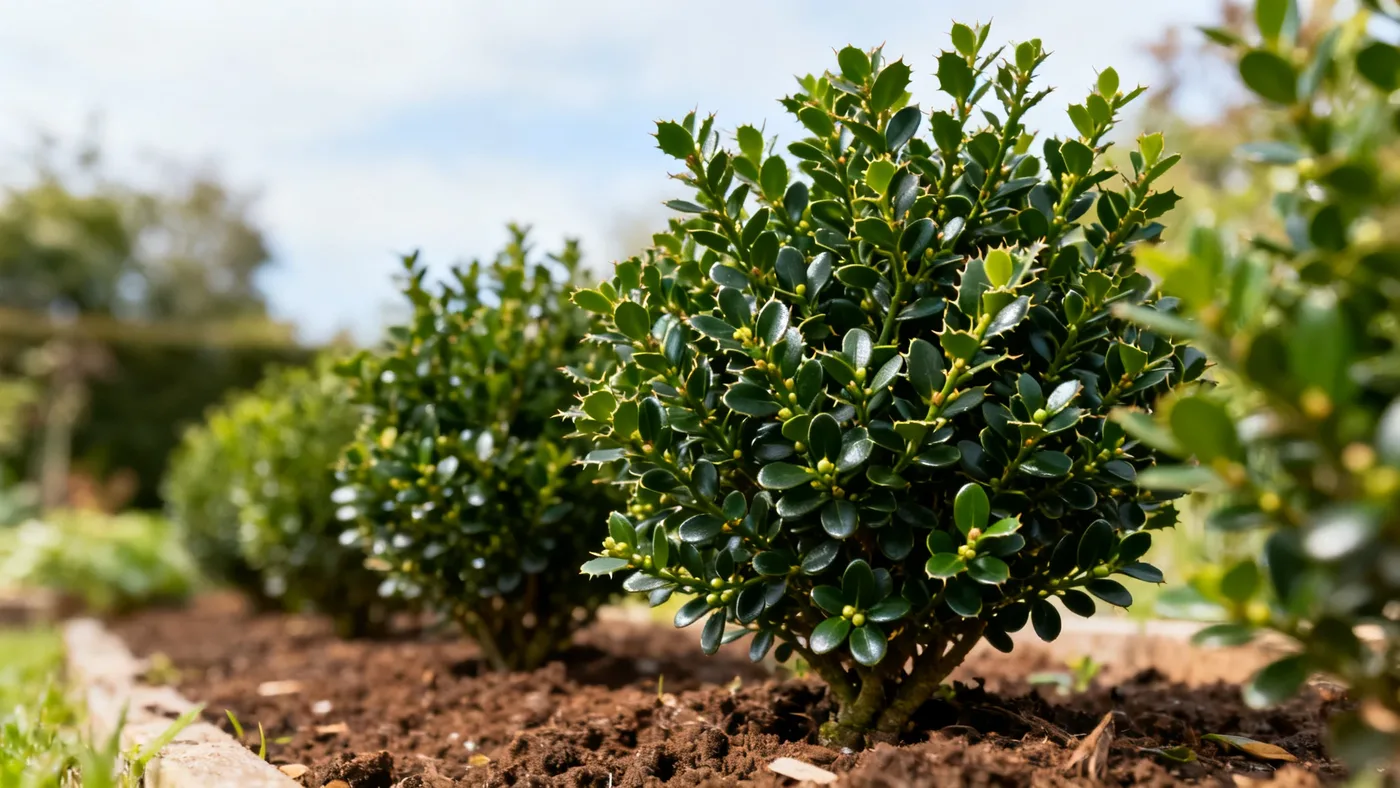
How Big and Fast-Growing Is Compact Japanese Holly?
One of the most common questions home gardeners ask about Compact Japanese Holly is whether it will stay truly compact or eventually outgrow its space. The good news: this cultivar lives up to its name, reaching a modest 3 to 4 feet tall and 4 to 5 feet wide at maturity, with a slow growth rate of just 3 to 6 inches per year. This makes it an excellent choice for foundation planting, low hedges, and tight spaces where other shrubs would quickly overwhelm the landscape.
Understanding Mature Size
How tall does Compact Japanese Holly get?
Compact Japanese Holly typically reaches 3 to 4 feet tall at maturity, with most specimens settling in the lower to middle range of that span. Under typical care and light pruning, you can expect the plant to stay within this height range for decades. If left completely unsheared over many years, it can stretch to 5 feet, though regular maintenance easily prevents this.
What is the mature width of Compact Japanese Holly?
The plant naturally spreads 4 to 5 feet wide at full maturity, developing a dense, rounded form. This width is wider than its height, so it creates a compact but full-bodied silhouette that works well as a foundation planting or specimen shrub. The proportions remain attractive even without aggressive shaping.
Will my Compact Japanese Holly stay small?
Yes, this cultivar is genuinely compact by design. It grows slowly and tops out at a manageable size, making it one of the few shrubs you can plant without worrying about annual pruning battles. A light shearing in late winter to early spring keeps it tidy, but the plant will not require constant attention to prevent it from taking over the landscape.
How does Compact Japanese Holly compare to boxwood in size?
Compact Japanese Holly is often used as a boxwood substitute, and they are quite similar in mature dimensions. Both typically reach 3 to 4 feet tall with a comparable spread. The key difference is that Japanese Holly's foliage is slightly larger (though still small and refined), and it offers superior disease resistance if boxwood blight is a concern in your area.
Growth Rate and Timeline
How fast does Compact Japanese Holly grow?
Compact Japanese Holly has a slow growth rate of approximately 3 to 6 inches per year. This measured pace makes it ideal for gardeners who prefer to plan their landscapes years in advance rather than deal with rapid overgrowth. The slow growth also means fewer pruning sessions and a more stable, predictable form season after season.
How long does it take to reach full size?
Reaching full mature size typically takes roughly 5 to 10 years, depending on planting conditions, sunlight, and care. At 3 to 6 inches per year, a nursery plant in a #1 or #3 container will spend several seasons filling in and establishing. This timeline is well worth the patience, as mature specimens become increasingly dense and visually striking.
Will my young plant look sparse for a few years?
Young Compact Japanese Holly plants benefit from establishment time before they develop the dense, full form you see in mature specimens. During the first year or two, consistent watering and light pruning encourage branching. By year three or four, the shrub should show noticeably fuller growth, though reaching peak density takes several more years.
Can I speed up the growth rate?
Over-fertilizing will push soft, leggy growth rather than dense, compact branching. Keep feeding minimal to moderate (light annual feeding in early spring with balanced or acid-forming fertilizer) and maintain consistent soil moisture instead. The slow growth rate is part of the plant's appeal, so working with it rather than against it yields better long-term results.
Spacing and Landscape Layout
How far apart should I space Compact Japanese Holly plants?
Space plants 3 to 4 feet apart for a continuous, low hedge. For specimen plantings or foundation use, allow 4 to 5 feet between plants. This spacing accounts for the mature width (4 to 5 feet) and ensures good air circulation, which helps prevent disease and allows each plant to develop its natural form.
Can I plant Compact Japanese Holly closer together?
Closer spacing (2 to 3 feet) will create a denser hedge faster, but plants will eventually require more aggressive pruning to prevent crowding. Standard spacing of 3 to 4 feet for hedges balances faster fill-in with less maintenance over the plant's lifespan. If you need immediate density, choose a wider spacing and accept that the hedge will take an extra year or two to knit together.
What are the best uses for this size shrub?
Compact Japanese Holly excels as a low clipped hedge, foundation planting, border edging, and topiary subject. Its modest height makes it perfect for foundation applications where you do not want plants blocking windows. The slow growth and dense branching also make it an ideal candidate for formal shapes and container growing on patios.
Is Compact Japanese Holly suitable for a small courtyard or patio?
Absolutely. Its 3 to 4 foot height and moderate width fit well in tight spaces without overwhelming the area. For additional control, many gardeners grow it in containers, though pots dry faster and require more frequent watering. Container planting keeps the root run in check and makes seasonal relocating easy if design changes are needed.
Regional Considerations
Does climate affect how big Compact Japanese Holly gets?
Compact Japanese Holly is hardy in USDA zones 6 to 8, though some nurseries list 5b to 8 with winter wind protection. Within these zones, the plant reaches its full 3 to 4 foot height regardless of location. In colder regions or windier exposures, foliage may bronze or yellow slightly in winter, but the mature size remains consistent.
Will my plant grow differently in zone 6 versus zone 8?
The mature size of 3 to 4 feet tall and 4 to 5 feet wide is consistent across zones 6 to 8. Growth rates may vary slightly based on season length and growing conditions, but the ultimate dimensions remain reliable. Choose your planting location based on sun (full sun to part shade) and soil drainage rather than expecting size differences based on zone.
Pruning and Shape Management
How does pruning affect the mature size?
Regular shearing in late winter to early spring before new growth flushes keeps Compact Japanese Holly at its desired height and shape without adding significant bulk. Light pruning actually encourages denser branching without pushing the plant toward its theoretical 5 foot maximum. A second light shearing in early summer is optional and maintains form through the growing season.
What happens if I do not prune my Compact Japanese Holly?
Unpruned plants will eventually reach toward the 5 foot upper end of their range if left unsheared for many years, developing a less formal appearance. However, they rarely become leggy or out of control like faster-growing shrubs. If size becomes an issue, the plant responds well to heavy renewal pruning and can be brought back to its original dimensions.
Can I shape Compact Japanese Holly into topiary?
Yes, the slow growth rate and dense branching make it an excellent topiary candidate. Small balls, cones, and formal geometric shapes can be trained over several years. The slow growth means topiary shaping is a multi-year project, but the payoff is a sculptural plant that holds its form with minimal maintenance once established.
Long-Term Performance
How long can I expect my Compact Japanese Holly to live?
Compact Japanese Holly is long-lived, commonly thriving for several decades or more (30 to 40+ years) with proper care. This lifespan, combined with its slow growth rate, makes it a reliable investment in a permanent landscape feature. Plan its placement with the understanding that it will likely outlive its neighbors.
Will the plant look the same at year 10 as it does at year 20?
A well-maintained specimen continues to develop increasing density and visual impact through its first 10 to 15 years. After reaching full maturity (around year 5 to 10), the plant stabilizes in size and appearance, though it continues to look healthy and attractive. With consistent care, there is no decline in form or vigor over decades.
Is there a maximum size I should plan for?
Plan for the upper range of 4 to 5 feet tall and 5 feet wide to be safe, though consistent light pruning keeps most specimens in the 3 to 4 foot range. If you have strict space constraints, light annual pruning easily maintains a smaller silhouette. The plant's slow growth means even if it approaches its maximum, corrective pruning is gradual and manageable.
Should I choose a different holly if I want something even smaller?
Other Ilex crenata cultivars offer different size options. Helleri, for example, grows even smaller, while Sky Pencil takes a narrow upright form. However, if a 3 to 4 foot shrub fits your space, Compact Japanese Holly offers excellent density and disease resistance. For detailed guidance on plant selection and proper techniques, see the planting guide and comprehensive care guide.
Quick Reference: Size and Growth at a Glance
| Measurement or Timeframe | Details |
|---|---|
| Mature Height | 3 to 4 feet (up to 5 feet if unsheared for many years) |
| Mature Width | 4 to 5 feet |
| Annual Growth Rate | 3 to 6 inches per year |
| Time to Full Maturity | 5 to 10 years |
| Spacing for Hedges | 3 to 4 feet apart |
| Spacing for Specimens | 4 to 5 feet apart |
| Hardy Zones | 6 to 8 (5b to 8 with winter protection) |
| Lifespan | 30 to 40+ years with proper care |
| Best Light | Full sun to part shade |
| Pruning Season | Late winter to early spring before new growth |