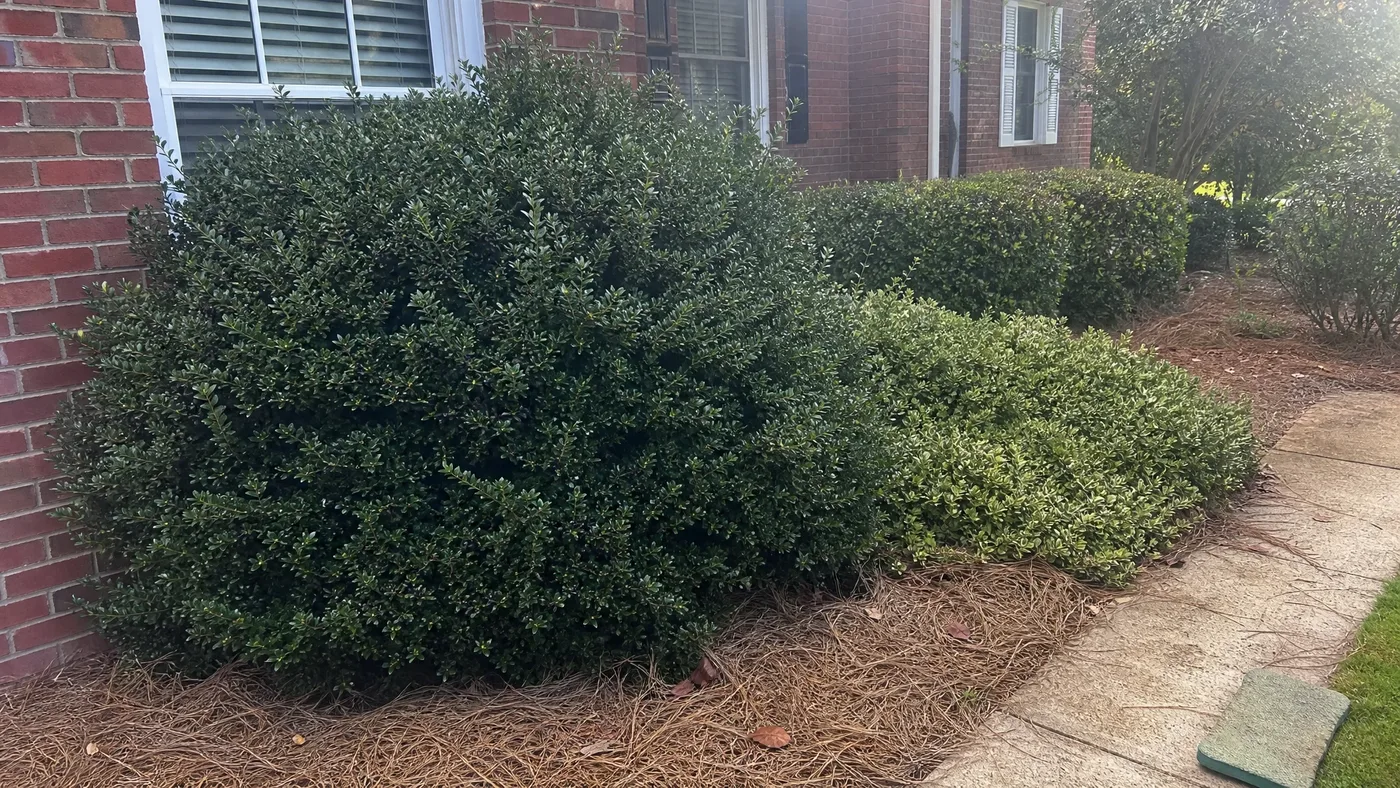
Compact Japanese Holly vs Soft Touch Holly: Size and Habit
Most people assume that choosing between Compact Japanese Holly and Soft Touch means studying two nearly identical dwarf hollies and hoping for the best. What we see instead is that the two pull apart quickly once you ask the right questions, and nobody picks wrong by taking those questions one at a time. Both are Ilex crenata, both are evergreen, and both have small, fine-textured leaves. They simply grow into different sizes and shapes.
Below, you'll find out all about how these two shrubs compare in a real yard, including overall shape, clearance under windows, spines along a path, foundation beds versus borders, planting the two together, and how each looks after ten years. Every section ends with a choice, so you can stop as soon as your answer is clear. Get this right and you avoid years of shearing a shrub back to fit a spot it was never going to fit.
Upright Compact Japanese Holly or a Low Mound?
Shape is the first decision because everything else follows from it. Picture the silhouette you want in that spot, then match it to the shrub that grows that way without much persuasion.
How Compact Japanese Holly Grows
Compact Japanese Holly, sold as Compacta, is a low, compact, globose shrub with a spreading habit. In practice it leans upright and rounded, and it is dense enough to hold a sheared cone or topiary shape. It matures at 6–8 feet tall and 6–10 feet wide, with a medium growth rate.
You may see smaller numbers on older plant tags. We go with the university figures, so plan for the larger size and you will not be surprised.
How Soft Touch Grows
Soft Touch is a different kind of plant. It is a dense, mounded evergreen with a moderate growth rate, and it reaches a relatively short height of about 3 feet. It does not reach for a point or try to become a cone. It sits low and round, like a cushion.
The practical difference is that Compacta gives you a shape you can direct, while Soft Touch gives you a shape that mostly stays where you put it. If you enjoy clipping, the first is a pleasure. If you do not, the second is a relief.
What the Species Tells You
It helps to know where Compacta sits among its relatives, because that explains why it is bigger than people expect.
The species itself grows 5–10 feet tall, so a 6–8 foot Compacta is a dwarf only by comparison with that. Soft Touch is the one that breaks furthest from the species, and that is why people choose it.
Our choice: pick Compacta if you want a vertical accent, a cone, or a sheared formal look. Pick Soft Touch if you want a calm, low mound that needs no steering.
Clearance Under Windows for Compact Japanese Holly
This is the decision that sends people back to the drawing board in year three, so it is worth ten minutes with a tape measure before you buy anything.
Measure Before You Choose
Measure from the soil to the bottom of the window sill, then compare that number to the mature height. Compacta is listed at 6–8 feet, which is taller than most sills. Soft Touch tops out around 3 feet, which clears most windows with room to spare.
If your sill sits lower than about 3 feet, even Soft Touch will reach it eventually. In that case plan on a light trim now and then, which this shrub tolerates well because it can be pruned to manage its size.
The Dwarf Label Can Mislead
Common advice says any "dwarf" holly is safe under a window. Dwarf is a relative word, and Compacta is dwarf only next to a tree. It stays under a window only if you shear it hard, year after year, and that fight is not worth having.
Customers usually ask us how to keep a Compacta below a window, and our honest answer is to put Soft Touch there instead.
Width Matters Too
Height is only half of the clearance question, because the shrub also needs room in front of the wall.
Compacta can spread 6–10 feet, so a single plant covers a lot of bed and can push against siding, steps or a neighboring shrub. Soft Touch is easy to transplant, so a placement mistake is cheap to fix. Compacta is a bigger commitment, and moving a mature one is a job for a weekend and a few helpers.
Our choice: Soft Touch goes directly under windows. Compacta belongs beside them, at corners, or between windows where it can grow without constant shearing.
Spines, Touch and Foot Traffic Along Walkways
For some yards this decides everything, and for others it hardly matters. It comes down to how close the shrub sits to people.
Soft Touch has soft-textured leaves without the sharp spines typically found on Japanese holly. That is the main reason it earns its name, and it is why it works well along walkways. Brush past it in shorts and you notice nothing.
Compacta has the standard Japanese holly leaf, small and glossy, with the pointed tips that come with it. We would not plant it where bare legs brush the foliage every day, or where children play along the edge of the bed. It also sets small black fruit. Eating the berries can cause a minor toxic reaction in people, and our guide to pets and children goes into the details.
Pruning Is Where You Feel It
The difference shows up again at trimming time, which many people forget to factor in.
Shearing Compacta means reaching into the foliage, so wear gloves and long sleeves. Soft Touch is far more pleasant to trim, and you can do it bare-handed without thinking twice. If you prune on a Saturday morning with the kids around, that matters more than it sounds.
Where Spines Do Not Matter
Some people worry that a pointed leaf rules Compacta out of a front yard altogether, and it does not.
Set back from the path, behind a lower edging plant or at a corner nobody brushes past, the leaf tips never meet anyone. For deer, the spines are not much help either, since Compacta is only mildly resistant to deer damage.
Our choice: pick Soft Touch for anything within arm's reach of a path, steps or a play area. Compacta is fine when it is set back from foot traffic.
Matching Each Shrub to Foundation Beds or Low Borders
Once shape, height and touch are settled, the bed itself usually makes the choice for you. Foundation beds and low borders ask for very different plants.
Foundation Beds
Compacta suits foundation plantings, hedges, shrub borders and formal gardens, and because it tolerates pruning it works for topiary as well. Its mature size makes it a corner anchor or a backdrop behind lower plants. Give it generous room from the wall so it does not press on the siding.
Check your soil first. Compacta is intolerant of alkaline soil and of drought, and the soil beside a foundation can run alkaline while a roof overhang keeps it dry. Test the pH before planting, and see our guide on landscape uses for Compact Japanese Holly for placement ideas.
Low Borders
Soft Touch is the better edging shrub, and the reasons are mostly about scale.
It works well in borders, as an accent, or along walkways, and at 3 feet it will not block the plants behind it. Use it along the front of a bed, beside a path, or around a patio, where a low evergreen keeps its shape through winter. A row of them reads as a tidy green edge rather than a hedge.
Our choice: Compacta for foundation corners and backdrops, Soft Touch for front-of-bed borders and edging.
Setting Compact Japanese Holly Beside the Lower Shrub
You can use both, and on a long bed it is often the best-looking answer. The only trick is placement.
Put the taller shrub at the back or at corners and the lower one in front, so the mound frames the cone rather than hiding it. Because Compacta can spread 6–10 feet, do not plant Soft Touch tight against it, or the larger shrub will crowd the smaller one over time. Leave a visible gap and let the bed fill in. A bare stretch of mulch in year one is normal and is the cheapest insurance you can buy.
Why They Share a Bed Well
The two get along because they are the same species and want similar conditions, which keeps the bed simple to look after.
Oregon State notes that Ilex crenata prefers light, moist, slightly acid soils, so one bed with one watering routine suits both. Our guide to companion plants covers what else to add.
A Note on Hardiness
Before you commit to a mixed planting, confirm that both shrubs suit your climate.
Compacta suits zones 6a–8b, with a caution about heat and humidity at the warm end. We have only the Compacta figures to give you, so check Soft Touch's hardiness for your area with your local extension service.
Our choice: mix them when the bed is long enough to give each its own space. On a short bed, choose one and repeat it.
Which One Do You Want After Ten Years?
This is the decision people skip, and it shapes how you will feel about the planting in year ten. Think honestly about how much pruning you want to do.
What Compacta Asks of You
Compacta grows at a medium rate and reaches 6–8 feet if left alone. Kept smaller than its mature size, Compacta needs regular trimming, and our guide on pruning Compact Japanese Holly shows how.
The reward is a firm, tidy shrub that keeps a cone or ball for as long as you keep up with it. Skip the pruning and you end up with a big, wide shrub and no room left in the bed. That is not a failure of the plant, only the size the university figures promised.
What Soft Touch Asks of You
Soft Touch is the low-effort plant. It can be pruned to manage its size, but at about 3 feet it rarely needs more than a light tidy. In our rows, it is the one customers forget about, which is exactly what most people want from a border shrub.
If you want growth numbers year by year, how big and fast-growing Compact Japanese Holly is covers them. Remember that Compacta is also drought intolerant, so a mature plant still needs attention in dry spells.
Our choice: pick Compacta if you like a trim every year and want a shrub with presence. Pick Soft Touch if you want about the same look in year ten that you planted.
Your Choice Made Simple for Compact Japanese Holly
Here is how the choices add up for common yards, so you can find yours and move on. For a front foundation with room to spare and corners to anchor, choose Compacta. For a bed under windows, along a walkway, or around a play area, choose Soft Touch. For a long mixed bed, use Compacta at the back and corners and Soft Touch along the front, with a gap between them. And if you dislike trimming, lean toward Soft Touch every time.
Compact Japanese Holly
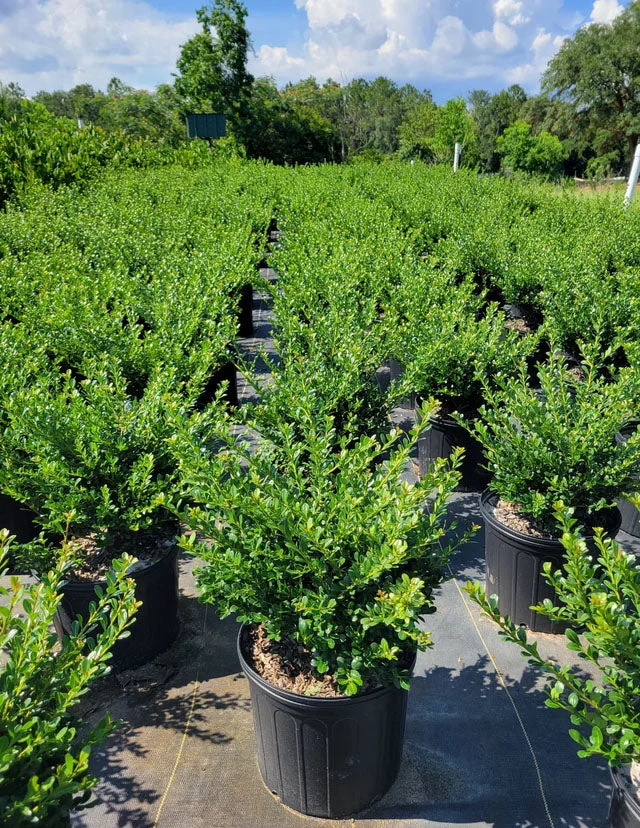
Nursery-grown Compact Japanese Holly in sizes from 1 Gallon Shrub, shipped to your door.
From $80.55
Shop Now →Either shrub will do well when it is matched to the right spot, so you cannot go far wrong. If you are still unsure, call or write in and tell us about the space. Every Compact Japanese Holly we ship leaves our own farms with a firm root ball in a snug pot and a wrapped crown, so the plant you unbox can go straight into the bed.