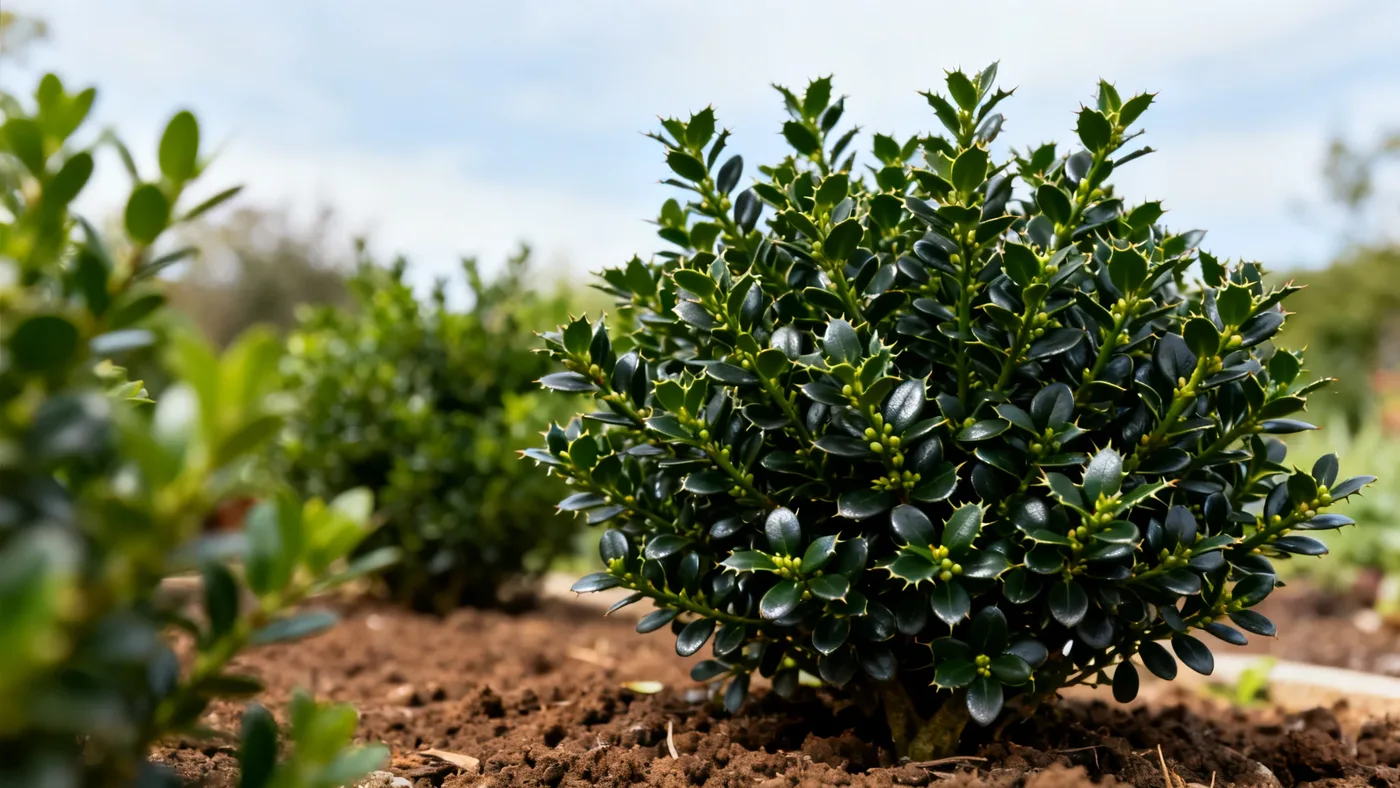
Compact Japanese Holly Varieties Compared: Compacta vs Helleri
If you're shopping for a dwarf Japanese holly cultivar, you've likely encountered Ilex crenata 'Compacta' and Ilex crenata 'Helleri' side by side at the nursery. Both are compact evergreen shrubs with small, glossy leaves and similar hardiness ranges, yet they serve different purposes in the garden. This comparison will help you choose the right cultivar for your landscape.
What Both Cultivars Have in Common
Before we compare specifics, let's note what Compacta and Helleri share: both are cultivated selections of the species Ilex crenata, both are evergreen shrubs with small (under 1 inch), dark glossy green, finely toothed leaves, and both thrive in similar climates and soil conditions. They're both excellent choices for formal hedges, foundation plantings, and topiary work. They also share similar pest and disease susceptibilities, spider mites, scale insects, and leafminer can affect either one. For a deep dive on care, see our compact Japanese holly care guide.
Both also offer reliable deer resistance. Japanese hollies are generally low on deer browse preference lists, making them a good choice if deer pressure is a concern in your area. Learn more about deer resistance and other wildlife considerations in our guide on whether Compact Japanese Holly is truly deer resistant.
Compact Japanese Holly 'Compacta': The Standard Dwarf
'Compacta' is the cultivar this site focuses on, and for good reason: it's been a landscape workhorse for decades. Here's what to expect.
Size and Growth Rate
'Compacta' reaches a mature height of 3 to 4 feet, with a width of 4 to 5 feet over several years. It's a slow grower, roughly 3 to 6 inches per year, so it takes time to fill in, but that deliberate pace makes it ideal for hedge work and topiary, where control is the goal. For hedging, space plants 3 to 4 feet apart for continuous coverage.
Hardiness and Climate
Hardy in USDA zones 6 to 8 (some nurseries list 5b with winter wind protection). In zone 6, foliage may bronze or yellow slightly in harsh, exposed sites, but the plant recovers come spring. Zone 8 is typically the warm limit; beyond that, summer heat and humidity can stress the plant.
Sun and Soil
Best density in full sun to light shade. In deep shade, foliage becomes thinner. Prefers well-drained, humus-rich loam with an acidic soil pH around 5.0 to 6.5. It tolerates clay if drainage is adequate but suffers in wet or soggy soil. Once established, it's moderately drought-tolerant but prefers consistent moisture throughout the growing season.
Seasonal Interest
Blooms in late spring (May to June) with small, inconspicuous white to greenish-white flowers. As a female selection, 'Compacta' can set small black berries, though fruiting is typically sparse compared to the species. Foliage remains dense and dark green through winter, with no fall color change.
Compact Japanese Holly 'Helleri': A Closer Comparison
'Helleri' is another dwarf cultivar of Ilex crenata, and while specific cultivar performance can vary by nursery and region, growers typically describe Helleri as more compact and slower-growing than Compacta. It often reaches 2 to 3 feet at maturity in managed conditions. It shares Compacta's hardiness range and similar cultural requirements: acidic, well-drained soil, consistent moisture, and full sun to part shade for best density.
The finer details of Helleri's exact mature size, growth rate, and regional performance vary across sources, so we recommend confirming specifics with your local extension service or nursery before planting. What's consistent is that Helleri is suitable for the same zones and conditions as Compacta, and it responds to shearing and renewal pruning in much the same way. Like Compacta, it works well in containers and tolerates formal pruning.
Other Dwarf Japanese Holly Cultivars Worth Knowing
If you're comparing multiple Japanese holly varieties, 'Green Island' often enters the conversation. Like Compacta and Helleri, it's a dwarf cultivar of Ilex crenata with small leaves and similar hardiness. Each cultivar has its champions among landscapers, and all three are legitimate alternatives to one another. The "best" choice depends more on your specific use case than on any single variety being objectively superior.
Side-by-Side Comparison Table
| Attribute | Compacta | Helleri |
|---|---|---|
| Mature Height | 3–4 ft (up to 5 ft unsheared) | Typically 2–3 ft* |
| Mature Width | 4–5 ft | Proportionally narrower* |
| Growth Rate | Slow: 3–6 in/year | Typically slower than Compacta* |
| USDA Zones | 6–8 (5b with protection) | 6–8 (similar range)* |
| Sun Requirement | Full sun to part shade | Full sun to part shade |
| Soil pH | Acidic: 5.0–6.5 | Acidic: 5.0–6.5 |
| Drought Tolerance | Moderate (once established) | Moderate (once established) |
| Deer Resistance | Good to high | Good to high |
| Typical Use | Hedges, foundation, topiary | Edging, borders, containers |
* Confirm exact specifications with your local nursery or extension service, as cultivar performance varies by region and propagation source.
Pros and Cons
Compacta: Pros
- Widely available at nurseries; easier to source in most regions
- Proven track record across decades of landscape use
- Versatile size allows for larger hedges and specimen plantings
- Responds predictably to shearing and formal pruning
- Moderate salt tolerance makes it suitable for coastal gardens
- Long-lived, typically 30 to 40+ years with proper care
Compacta: Cons
- Slower to establish than some growers prefer (takes years to fill a hedge)
- Susceptible to chlorosis (yellowing) in alkaline soil; requires acidic conditions
- Winter burn and foliage bronzing in harsh, exposed zone 6 sites
- Vulnerable to spider mites in hot, dry conditions
- Can develop root rot if soil stays wet or soggy
Helleri: Pros
- More compact form makes it ideal for tight spaces and edging
- Typically slower-growing, reducing annual pruning requirements
- Excellent choice for small-scale topiary and formal containers
- Similar hardiness and disease resistance to Compacta
- Better proportioned for small foundation plantings
Helleri: Cons
- Less widely available than Compacta at some regional nurseries
- Smaller mature size means it cannot substitute for Compacta in large hedge projects
- Regional performance data is less extensive; confirm cultivar details with your nursery
- May require special order at some locations
Best For: Use-Case Recommendations
Choose Compacta If You Want:
- A larger hedge (3 to 5 feet tall and wide) with proven longevity
- Foundation planting that fills a substantial footprint
- A versatile cultivar for mixed evergreen borders and massed plantings
- Wider availability and established nursery supply chains
- Moderate salt tolerance for near-coastal or road-salt-exposed sites
- A boxwood alternative with documented disease resistance
Choose Helleri If You Want:
- A tighter, more compact form for small spaces and tight corners
- Edging or low borders under 3 feet tall
- A formal small specimen or container plant for patios
- Minimal annual pruning (its slow growth means less frequent shearing)
- A distinctive, refined cultivar that stands out from standard Compacta
- A container-friendly option that doesn't outgrow its pot
The Verdict
There is no objectively "best" Japanese holly cultivar, only the best choice for your specific garden. Compacta excels as a reliable, widely available standard for larger hedges, foundation plantings, and formal landscapes. Helleri shines when space is at a premium or when you want a more refined, tighter form. Both are hardy, pest-resistant, and long-lived with proper care. Both thrive in acidic, well-drained soil and prefer full sun to light shade. Both deserve a place in a well-planned landscape.
Before buying, visit your local nursery in person if you can. See the plants side by side, ask staff about regional performance and availability, and consider the exact footprint you're planting into. That site-specific perspective will guide you better than any chart.
Quick Reference Checklist
| Decision Point | Compacta | Helleri |
|---|---|---|
| Space available: 4+ ft wide | ✓ | n/a |
| Space available: under 3 ft wide | n/a | ✓ |
| Hedge height: 3–5 ft tall | ✓ | n/a |
| Edging or border under 3 ft | n/a | ✓ |
| Container or patio planting | ✓ (larger pots) | ✓ |
| Zone 6–8 hardiness required | ✓ | ✓ |
| Acidic soil (pH 5.0–6.5) | ✓ | ✓ |
| Low to moderate maintenance | ✓ | ✓ |
| Widely available locally | ✓ | n/a |
| Coastal/salt-exposure site | ✓ | n/a |