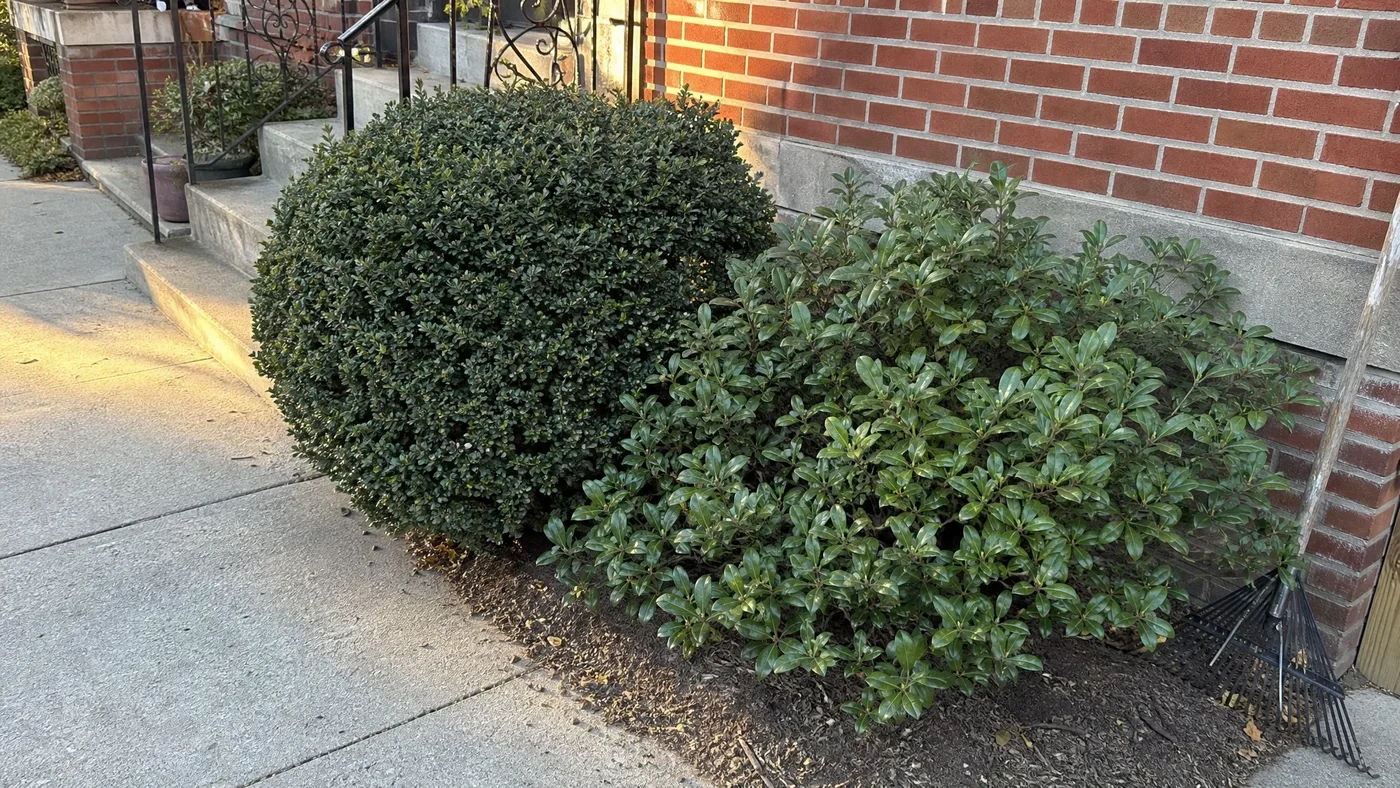
Compact Japanese Holly vs Compact Inkberry Holly: Key Differences
One cultivar name. Two species. Inkberry leaves reach 1.5 inches long, and Compact Japanese Holly leaves are small with a toothed edge, which settles most mix-ups before a spade goes in the ground. Every late winter, when spring orders go in, the same error starts: a buyer searches for a "Compacta" holly and receives the wrong shrub.
Both plants are rounded, dark green and sold as boxwood-style shrubs. They differ in native range, soil, spread and tag. A wrong pick costs you a bed and several seasons.
This article talks about how to tell Ilex crenata 'Compacta' from Ilex glabra 'Compacta' and answers the questions customers ask us most. Read on to learn how the leaves compare, which soil each shrub wants, where each one fails, how hardiness and light differ, and what to check on the tag before you pay.
One Cultivar Name on Two Unrelated Shrubs
The facts first. Two different species carry the name 'Compacta' in the nursery trade, and a shared cultivar name does not make them kin.
Same Label, Different Species
Compact Japanese Holly is Ilex crenata 'Compacta'. Compact inkberry holly is Ilex glabra 'Compacta'. A cultivar name is a label a grower attaches to one selected form of a plant. Two selections from two species can end up with the same label, and here they did.
Our Compacta vs Helleri comparison covers the Japanese side and never mentions inkberry. This guide fills that gap.
Why Search Results Mix Them Up
The confusion starts with the words people type, not with the plants.
"Compacta holly," "compact holly" and "compact inkberry" all return pages for both shrubs. Retail listings often drop the species name and keep only the nickname. We tell customers to write down the botanical name, genus and species both, and to match that against the tag. The common name alone is not enough to identify either shrub.
Where Each One Comes From
Native range explains most of the differences that follow, so we start there.
Ilex crenata is native to Japan and Korea. Ilex glabra is native to the southeastern United States, and in the wild it grows beside swamps and bogs. One shrub evolved in Asia. The other evolved at the edge of wet ground in the American Southeast.
The rounded shape comes from selection and shearing, not shared ancestry. Treat them as two plants that happen to wear the same tag.
Compact Japanese Holly Leaves Against Inkberry Leaves, Measured
Leaves are the fastest test. Hold one in your hand and you can name the species in seconds.
Length, Shape and Edge
Inkberry leaves are up to 1.5 inches long, glossy and dark green, with smooth margins and several teeth near the tip only. The leaf is spineless and flat, ovate to elliptic.
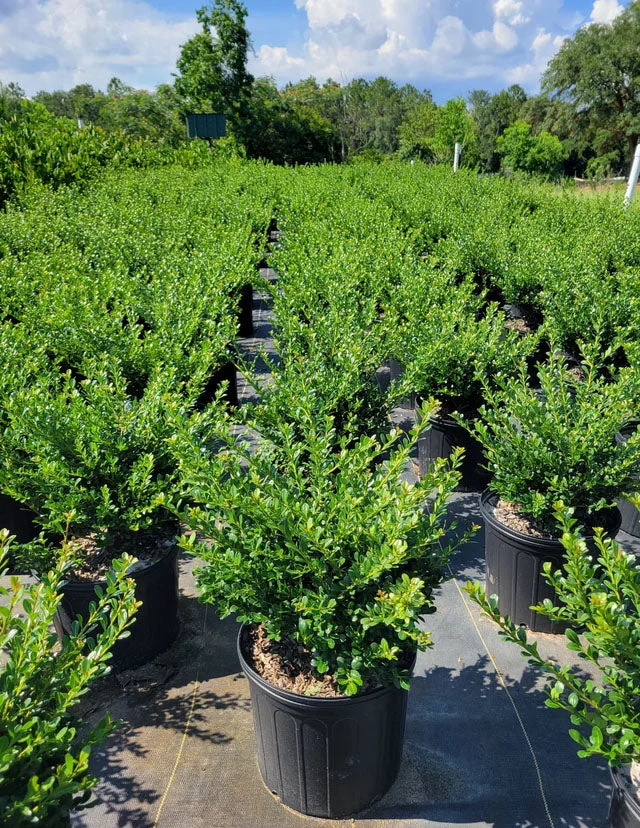
Compact Japanese Holly leaves are small, obovate and a lustrous dark green, with crenate-serrulate teeth. That means small rounded teeth along the whole edge, not just at the tip. Our sources give no length figure for Compacta leaves, so measure the leaf in your hand against the 1.5 inch inkberry ceiling.
Leaf, Range and Size in One Table
The table sets the two shrubs next to each other, row by row. The inkberry size figures are for the species, so ask any seller for the cultivar's own numbers.
| Trait | Compact Japanese Holly | Inkberry |
|---|---|---|
| Botanical name | Ilex crenata 'Compacta' | Ilex glabra |
| Native range | Japan, Korea | Southeastern USA |
| Leaf length | Small, no figure given | Up to 1.5 inches |
| Leaf edge | Small teeth along the margin | Smooth, a few teeth near the tip |
| Height | 6–8 feet | 5–10 feet (species) |
| Width | 6–10 feet | 5–8 feet (species) |
| Suckers | No colony habit listed | Yes, forms colonies |
Size in Year Five
One correction to common advice: "compact" does not mean small. Compacta grows 6–8 feet tall and 6–10 feet wide, with a medium growth rate. Plan year five around that, not a knee-high ball.
Inkberry looks tidy in the pot and then widens by suckering, forming colonies. Compact Japanese Holly widens by branching, so its edge stays where the shears leave it. Our size and growth guide has the details.
Flowers and Berries
Flowers will not separate the two shrubs from a distance, so do not rely on them at the nursery.
The Compact Japanese Holly species bears small, white, 4-parted flowers from May to June, and the Compacta flowers are fragrant. They are small enough that most people never notice them. Buy for the leaf and the site, not the bloom.
Wet Feet for Inkberry, Drained Soil for Compact Japanese Holly
Soil moisture is where the two plants part ways most sharply. It decides which bed each one can live in.
What Inkberry Tolerates
Inkberry tolerates moist, even occasionally wet soil. That fits its habit of growing beside swamps and bogs. A low corner that stays soggy after storms is inkberry territory.
What Compact Japanese Holly Needs
Compact Japanese Holly is not a bog plant, and it is not a dry-soil plant either. Compacta does not tolerate alkaline soil or drought, but it copes with poor sandy soil. Oregon State says the species prefers light, moist, slightly acid soil.
That describes a drained, acid bed that still gets water in dry spells. Our soil and drainage guide shows how to test and amend.
A Drainage Test Before You Choose
Do this before you buy either plant. It takes one afternoon.
Dig a hole the size of the root ball and fill it with water. Fill it again after it drains. If water is still standing the next morning, the spot suits inkberry or needs drainage work. If it empties and the soil is sandy or loamy and acid, the spot suits Compact Japanese Holly.
Keep in mind that limed or alkaline soil is a problem for Compacta even when drainage is perfect. Check pH as well as drainage.
Right Tag, Wrong Plant in Your Compact Japanese Holly Bed
A tag can be accurate and still be wrong for your site. Here is how each mismatch plays out.
Inkberry Where You Wanted a Tight Hedge
Inkberry suckers to form colonies. Plant it in a narrow strip and it sends up shoots beyond the line you drew. By year five, a hedge meant to stay in its bed is wandering into the lawn.
One of the most common questions we get is whether "compacta holly" means one plant. It does not, and the nickname will not tell you which you are buying.
Compact Japanese Holly in a Wet Corner
The reverse mistake is worse. Compact Japanese Holly in a low, wet bed sits outside the conditions our sources describe for it. Good looks on the tag do not fix a bad site.
Watch the first season closely. If growth stalls or thins while the plant sits in standing water, lift it and move it to drained ground rather than waiting. Compacta occasionally gets spider mites and nematodes, and a stressed plant is the one that tends to show them first.
Which We Would Choose
We choose Compact Japanese Holly for drained, acid beds in sun where you want a neat, small-leaved, boxwood look. We choose inkberry for wet spots and informal screens that can handle some spreading.
For a formal foundation line, our pick is Compact Japanese Holly. For a rain garden edge, it is inkberry, and we would not argue the point.
Cold Hardiness Zones Side to Side
Zone numbers matter less than soil, but they still decide what survives your winters.
Compact Japanese Holly Zones
Compacta is hardy in zones 6a to 8b. The species is hardy in zones 5a to 8b, so the cultivar is slightly less cold-tolerant than its parent. Do not carry the species range over to Compacta.
The warm edge needs care too. Compacta may not thrive in areas with high heat and humidity, in zones 8 and 9. We treat zone 8 as the edge of its range.
What We Can Say About Inkberry
The sources we use for this guide give no inkberry zone range, so we will not quote one.
Ask your local extension service for the zone range of the specific inkberry cultivar you plan to buy, and ask about the hot end of your climate too. Our hardiness zone guide covers the Japanese side in full.
Sun and Shade Limits for Each Shrub
Light is the third test. Compact Japanese Holly has clear numbers in our sources. Inkberry does not.
Compact Japanese Holly in Sun
Compacta does best in full sun, meaning 6 or more hours of direct sunlight a day. Oregon State gives the species as sun to part shade. We read that as full sun first, with part shade as the fallback. Plan on part shade at the most.
Our sun and shade guide explains what the plant does when it gets less.
Inkberry and Shade
For inkberry, our sources give no light figure. Its habit of growing at the edge of swamps and bogs tells you about moisture, not shade.
Check with your extension service before you plant inkberry in a shaded bed. We will not guess at a number our sources do not support.
Test Your Own Spot
Either way, test the site before you buy. Count the hours of direct sun on a clear day, from morning to late afternoon. A bed with 6 or more hours suits Compacta. A bed with fewer hours is part shade, and you should expect a weaker result.
Write the count down and take it with you when you shop. It settles the argument at the nursery gate.
Reading the Tag on Compact Japanese Holly Before Paying
A short check at the tag saves a wrong planting. Run through this list before you pay.
- The botanical name reads Ilex crenata 'Compacta'. If it reads Ilex glabra, you are holding inkberry.
- The leaves are small, glossy and toothed along the edge. Smooth margins with teeth only near the tip mean inkberry.
- No leaf is longer than 1.5 inches, and most look visibly smaller than that.
- The tag or seller describes drained, acid soil. Wet-site language points to inkberry.
- The mature size is given as 6–8 feet tall and 6–10 feet wide for Compacta, not a "dwarf" claim.
- The seller can name the species in full, not only the nickname "compact holly".
Questions for the Seller
If the tag is vague, ask these before you hand over money.
Ask for the botanical name in writing, and ask where the plant was grown. A seller who cannot confirm the species cannot tell you what soil it wants. If the answer is only "it's a compact holly," we would not buy. Our buying guide adds what to check once the name is confirmed, from container size to root condition.
Two Hollies, One Name, One Right Choice
Two species share one cultivar name, and only one is Compact Japanese Holly. Choose it for drained, acid soil, full sun and a tight, small-leaved shape. Choose inkberry for wet ground and a looser, suckering habit, and check its zone and light needs locally first.
Compact Japanese Holly
Nursery-grown Compact Japanese Holly in sizes from 1 Gallon Shrub, shipped to your door.
From $80.55
Shop Now →Ilex crenata 'Compacta' is the Latin name. The leaves are small, glossy and toothed. The site is drained, acid soil in sun. On our farms, we give Compact Japanese Holly well-drained acid soil and full sun, and we water through dry spells because it does not tolerate drought. We are a small business, and we grow and sell top-quality shrubs.