Sun and Shade Needs for Compact Japanese Holly Explained
Compact Japanese Holly thrives in full sun to part shade, but light availability affects both how the plant looks and performs over time. Understanding your site's light conditions and recognizing what the plant needs at each stage helps you make the best planting decision. This guide walks you through assessing your yard's light, matching it to Compact Japanese Holly's requirements, and recognizing when to adjust shade or exposure for best results.
Understanding Compact Japanese Holly's Light Needs
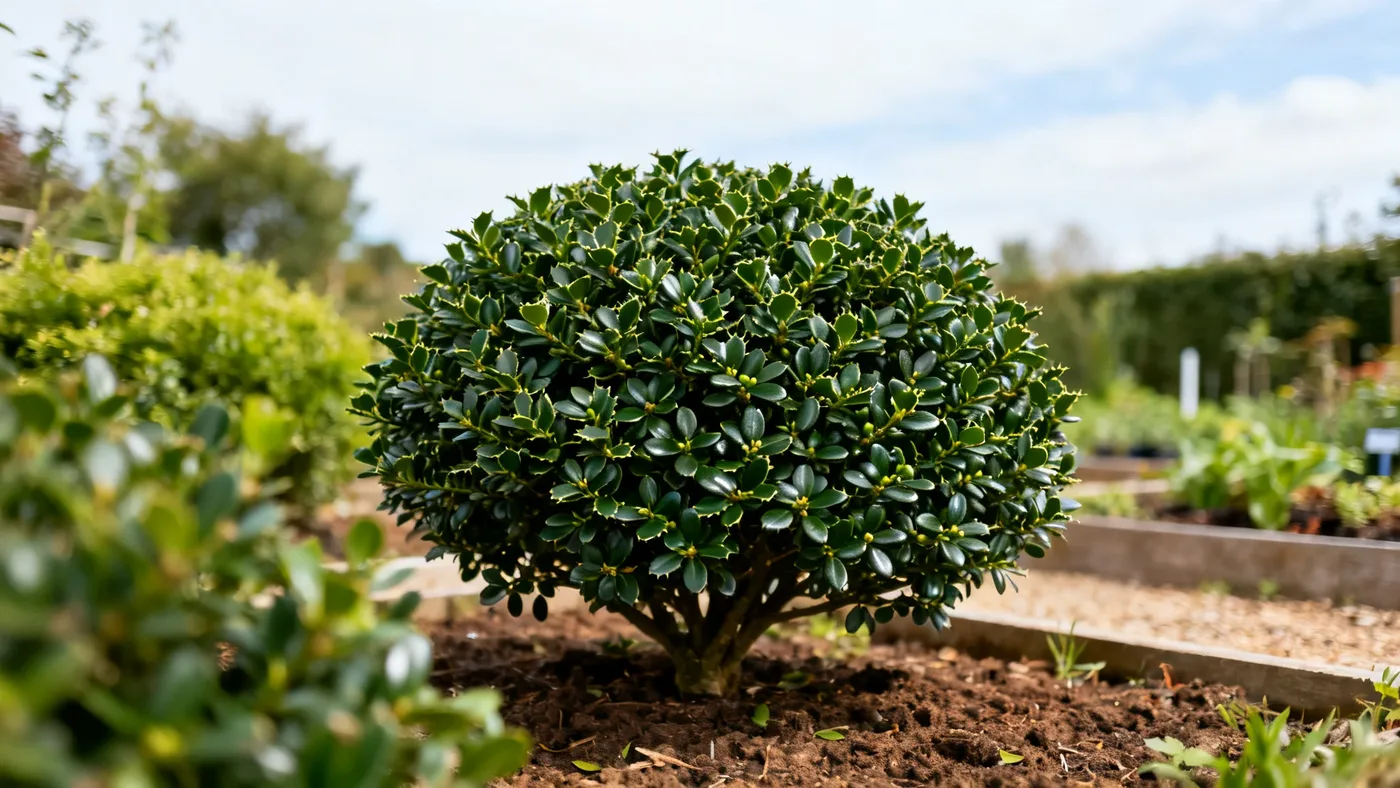
Compact Japanese Holly achieves its best density and appearance in full sun to light shade. This means the plant performs well across a range of light environments, but the quality of growth varies. In full sun to light shade, the foliage grows tight and dark green, with minimal gaps between stems. As light decreases, growth slows further and the plant becomes less dense, meaning branches space farther apart and the form looks more open.
Light also affects the plant's vigor in other ways. Plants in ideal light conditions are more resilient to stress, recover faster from pruning, and resist pests and diseases more effectively than those struggling in poor light. Even though Compact Japanese Holly tolerates part shade, plants in shadier spots often show delayed growth and may not reach mature size as quickly.
Step 1: Identify Your Site's Light Pattern Over One Week
Before planting, map out how many hours of direct sunlight your proposed site receives. Direct sunlight means unobstructed rays reaching the ground without filtering through tree canopies or building shade. Partial shade means the site receives some direct sun but is shaded for part of the day by trees, buildings, or other structures.
Choose the planting location and observe it from early morning through late afternoon on a sunny day. Record when shade moves across the spot and for how long. Do this on at least one clear day to see the full pattern. Look for permanent shade sources: trees to the north and west typically cast afternoon shade, while north-side building walls create all-day shade.
Count the hours of direct sunlight your site gets between 9 a.m. and 5 p.m. This is the simplest way to classify light. Full sun sites receive 6+ hours of direct sun during peak daylight hours. Light shade sites receive 4 to 6 hours. Part shade to mostly shaded sites receive less than 4 hours of direct sun or dappled sun under thin tree canopy.
Step 2: Evaluate Your Site's Shade Type
Not all shade is equal. High tree shade (dappled light filtering through leaves above head height) differs significantly from ground-level shade cast by structures or dense hedges. Compact Japanese Holly performs better under high tree shade than under dense structural shade because some light still reaches the foliage.
Walk around your intended planting area mid-morning and again around 3 p.m. In areas that will be shaded, observe whether the shade comes from deciduous trees (which lose leaves in winter, letting through more light), evergreen trees (which block light year-round), or structures. Dappled shade under high trees is preferable for Compact Japanese Holly; solid shade from a north-facing wall is the most challenging light condition.
Consider seasonal changes if your site is under deciduous trees. In summer, shade will be deeper. In spring and fall, much more light reaches through the canopy. If your site is shaded primarily by deciduous trees, you may find the plant performs better in spring and early fall when light is abundant, and slower during the deep shade of summer.
Step 3: Assess Current Vegetation and Site History
If your planting location already has plants thriving nearby, this tells you about the light conditions. Shade-loving plants like hostas, ferns, and certain rhododendrons indicate lower light. Full-sun plants like ornamental grasses and coreopsis indicate abundant light. If the spot is bare or weedy, the light level may be marginal for most plants, which suggests limited hours or poor quality light.
Ask the property owner how long they have been observing the site. Mature trees and building positions don't change quickly, so light patterns observed over several years are reliable. If trees are young and still growing, shade will deepen over time. If trees are mature and established, the shade pattern is stable and predictable.
Step 4: Match Light Conditions to Planting Goals
Decide what you want Compact Japanese Holly to do. For a dense, formal clipped hedge or topiary, plant in full sun to light shade. Full sun allows the plant to reach its best density and hold a clean shape without gaps. For foundation plantings where a slightly more open form is acceptable, light shade works well. If your only available spot is in part shade (4 or fewer hours of direct sun), Compact Japanese Holly will survive and grow, but expect slower growth and a looser appearance.
If you are using Compact Japanese Holly as a substitute for boxwood, remember that both plants prefer light conditions. Boxwood shows the same trend: better density in full sun and more open growth in shade. If your reason for choosing Compact Japanese Holly over boxwood is disease resistance in your climate, light conditions remain important to plant performance regardless of which species you plant.
Step 5: Monitor Plant Response for the First Growing Season
After planting, track how Compact Japanese Holly responds to its light conditions. In the first full growing season, note the color of new growth, the spacing of leaves, and how quickly the plant extends new stems. Dark green, tightly spaced new leaves indicate the plant is thriving. Pale or yellowish new growth, or leaves spaced far apart with visible gaps between them, suggests the plant is adapting to less-than-ideal light or soil conditions.
Compact Japanese Holly grows roughly 3 to 6 inches per year. In full sun to light shade, expect growth toward the faster end of this range. In part shade, growth may slow to the lower end or less. If your plant has grown noticeably less than 3 inches after one full year, light is likely limiting growth, and you should assess whether pruning nearby trees or relocating the plant is feasible.
Water and soil also affect growth rate, so don't attribute all slow growth to light alone. A plant in good light but dry, compacted, or poorly drained soil will also grow slowly. Review the full Compact Japanese Holly care guide to confirm you have provided consistent moisture and well-drained soil before concluding that light is the limiting factor.
Step 6: Adjust Shade or Exposure if Needed
If after one season you find the plant is too shaded, you have limited options. Removing overhead tree branches to increase light penetration is possible but requires professional arborists for large trees and should only be done if you own the trees. For hedges or foundation plants that are too open or pale, consider whether adding supplemental water and fertilizer might help the plant fill in before making major changes.
If the plant is in too much sun and stress is evident (browning foliage, wilting during heat waves despite adequate water), afternoon shade cloth in the hottest months of summer can provide temporary relief. This is rarely necessary for Compact Japanese Holly, which is hardy in USDA zones 6 to 8, but exceptionally hot sites in zone 8 may benefit from afternoon shade during peak summer.
Common Mistakes to Avoid
Assuming afternoon sun is the same as morning sun is a common error. Morning sun combined with afternoon shade is ideal for many plants; afternoon sun combined with morning shade is more stressful because plants face peak heat. Compact Japanese Holly tolerates both, but the plant performs better when afternoon heat is moderated by some shade in hot climates.
Underestimating how much shade tree canopies cast is another frequent mistake. A tree that looks sparse and open in winter can create surprisingly deep shade by mid-summer. If you are planning around deciduous tree shade in winter, be prepared for much less light once the tree leafs out.
Confusing reflected heat with direct sun is also easy to do. A south-facing wall or paved area reflects and concentrates heat, making the effective temperature much higher than air temperature. Compact Japanese Holly can handle full sun but prefers consistent moisture in these high-heat spots. Don't assume reflected-heat sites need the same water schedule as open-sun sites.
Expected Results and Timeline
In full sun to light shade with good soil and consistent water, expect Compact Japanese Holly to develop a dense form within 2 to 3 growing seasons. By year 3 or 4, the plant should show noticeably tight branching and good coverage if you are shearing it regularly. In part shade, the same plant will reach full density more slowly, over 4 to 5 years, and may never achieve quite the same tightness as sun-grown plants.
Foliage color will also improve over the first year or two. Newly planted Compact Japanese Holly sometimes shows slightly lighter green foliage as it establishes. By the second growing season, foliage should be rich, dark green if light and soil are adequate. If foliage remains pale yellow-green after two seasons, investigate whether poor drainage, alkaline soil, or lack of light is responsible before concluding the plant is simply not thriving in your site.
Quick Reference: Light Conditions and Plant Performance
| Light Condition | Hours of Direct Sun | Shade Type | Plant Density | Growth Rate | Best For |
|---|---|---|---|---|---|
| Full Sun | 6+ hours | None or minimal | Dense, compact form | Faster (toward 6 in/year) | Hedges, topiary, formal shapes |
| Light Shade | 4-6 hours | Dappled or afternoon shade | Good density | Moderate (3-5 in/year) | Foundation plants, mixed borders |
| Part Shade | 2-4 hours | Significant structural or tree shade | More open form, visible gaps | Slower (2-3 in/year or less) | Understory planting; less ideal |
| Heavy Shade | Less than 2 hours | All-day shadow from building or dense canopy | Sparse, leggy growth | Very slow or stalled | Not recommended |
Pre-Planting Checklist
- Map sunlight hours at the proposed planting site across a full sunny day
- Identify shade source: deciduous tree, evergreen tree, building, or structure
- Note whether shade is high (dappled) or ground-level (solid)
- Observe existing plants at the site to confirm light classification
- Plan for seasonal light changes if trees are involved
- Confirm soil drainage and moisture availability independent of light assessment
- Decide whether light conditions match your intended use (hedge vs. foundation vs. specimen)