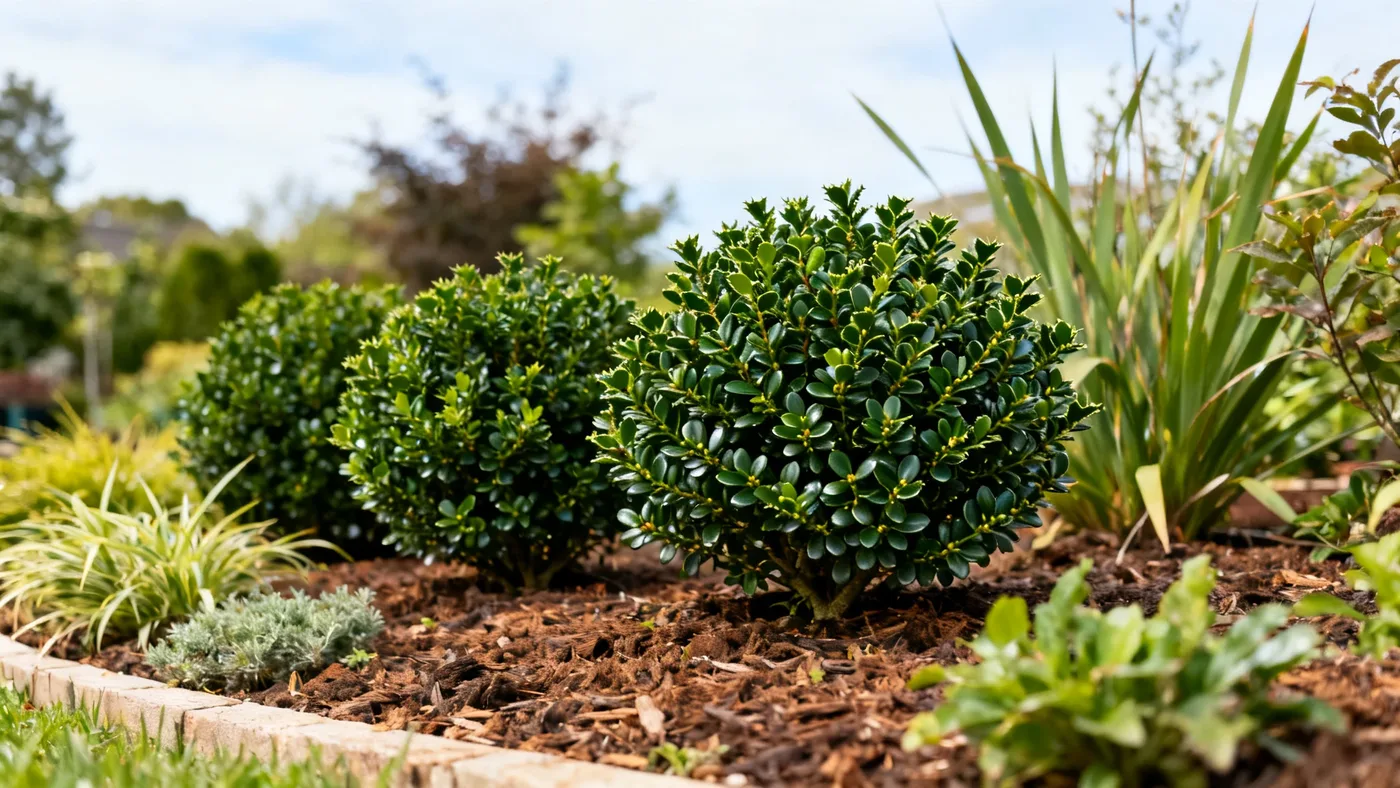
Best Landscape Uses for Compact Japanese Holly in Your Yard
Compact Japanese Holly (Ilex crenata 'Compacta') has become a staple in residential landscapes across USDA zones 6-8 for a reason. Its small, glossy dark-green leaves, slow and predictable growth, and naturally dense form give it versatility that most evergreens can't match. Whether you're looking to define a property edge, frame a doorway, or add structure to a mixed bed, this cultivar adapts to far more roles than many gardeners realize. If you're exploring compact japanese holly landscape uses, you'll find this plant works reliably in everything from formal hedges to container specimens.
1. Low Clipped Hedges and Screens
The classic use for Compact Japanese Holly is as a formal, low-growing hedge. It grows slowly, roughly 3-6 inches per year, which means you can maintain a tight, manicured line for decades without constant vigilance. The foliage is so dense that even a newly installed hedge row reads as full and polished within a season. For a continuous hedge, space plants 3-4 feet apart; they'll knit together as they mature.
Best results come in full sun to light shade, where the plant develops maximum density and holds its color. If you're gathering compact japanese holly hedge ideas, keep in mind this cultivar tops out around 3-4 feet tall, making it ideal for defining boundaries without blocking views or light. Pruning is straightforward: shear in late winter to early spring before new growth flushes. You can take a light second shearing in early summer if the plant gets ahead of you. The deep evergreen backdrop makes a striking stage for colorful perennials or spring bulbs planted in front.
Practical takeaway: Plant 3-4 feet apart in spring or early fall. Water regularly through the first season, then maintain consistent moisture (not soggy). Allow young hedges 2-3 seasons to fill in fully before expecting that polished, dense appearance.
2. Foundation Planting for Year-Round Structure
Compact Japanese Holly excels as a compact japanese holly foundation planting choice, especially in regions where winter greenery matters as much as summer color. Unlike deciduous shrubs that vanish in cold months, this holly holds its neat, dark-green silhouette year-round. Its mature height of 3-4 feet and width of 4-5 feet strike the right proportion for most home facades without eventually swallowing windows or overwhelming the entry.
A well-designed foundation typically layers different shrub sizes to draw the eye toward the door or window. Compact Japanese Holly works beautifully as a middle-layer anchor, with lower edging plants in front and taller specimens at corners. Its fine-textured foliage complements softer plants like hostas, ferns, and Japanese forest grasses. Pair it with azaleas or rhododendrons in acidic-soil gardens for an elegant, cohesive look. Space plants 4-5 feet apart when planting as individual specimens, leaving room for mature width and airflow.
Practical takeaway: Choose a site with good drainage and as much morning sun as your home allows. Amend the soil heavily with compost to create the well-drained, acidic conditions it needs (pH 5.0-6.5). The plant will yellow in alkaline soil, so test first. For complete care instructions, see our Compact Japanese Holly care guide.
3. Formal Edging and Borders
When you want to edge a pathway, separate a lawn from planting beds, or delineate a vegetable garden, Compact Japanese Holly stops being an option and becomes a solution. The slow growth rate means you won't spend half your summer pushing encroaching branches back off the driveway or lawn. A single row spaced 3-4 feet apart creates a leafy border that looks intentional and architectural without demanding constant attention.
Edging work showcases the plant's dense, low habit perfectly. Kept at 2-3 feet tall with annual shearing, the foliage stays thick and uniform from base to tip. There are no leggy gaps that plague faster-growing hedging plants. In full sun, the foliage deepens to nearly black-green, creating dramatic contrast with adjacent turf or mulch colors.
Practical takeaway: Mark your line with string or chalk before digging. Space 3-4 feet apart, backfill with amended soil, and water thoroughly. One light shearing each year in late winter maintains a neat profile; heavy pruning is rarely needed.
4. Topiary and Formal Shapes
The dense branching structure and small leaves of Compact Japanese Holly make it an excellent candidate for topiary. This cultivar responds cleanly to heavy pruning and can be shaped into pyramids, spheres, cubes, or custom forms over time. In formal European gardens and high-end residential landscapes, you'll find this plant clipped into precise geometric shapes that anchor entire planting schemes.
Creating topiary requires patience given the 3-6 inch annual growth rate, but the payoff is a sculptural element that adds sophistication to a design. You can use a metal frame or hand-prune to your desired form. The small leaves and tight growth habit mean new shoots fill behind your cuts within weeks, yielding a polished surface year after year. This works equally well for in-ground beds and large containers.
Practical takeaway: Start with a young plant and commit to consistent yearly pruning. Use clean, sharp pruners. Prune in late winter or early spring, then allow one growth flush before taking a light second shearing in early summer if needed. Avoid pruning during active growth flushes.
5. Mass Planting for Landscape Structure
When landscaping with japanese holly compacta at scale, mass planting creates powerful visual and spatial impact. Five, ten, or twenty plants arranged in drifts or curved rows establish landscape structure and can define outdoor rooms in large gardens. The slow growth rate actually works in your favor; you won't face a maintenance crisis if one plant outgrows the rest.
Mass plantings work best on sloped terrain, where plants can cascade down an incline, or in broad foundation beds where you want unified visual weight. Space plants 4-5 feet apart for mature spacing, or closer if you want them to fill faster (though it will take longer). Companion plants for compact japanese holly include shade-tolerant options like hostas, Japanese painted ferns, azaleas, and rhododendrons. All these plants share a preference for acidic, well-drained soil, making them ideal neighbors.
Practical takeaway: Mass planting is a long-term investment. Allow 5-10 years for plants to reach mature size and fill the space completely. Consistent watering during establishment (the first season) and annual spring pruning accelerate the transition and keep the planting looking intentional.
6. Container Specimens for Patios and Entries
Compact Japanese Holly thrives in containers, making it perfect for patios, formal entries, or rooftop gardens. The slow growth habit and refined foliage are especially attractive in pot culture, where the plant won't outgrow its container in a few seasons. A matching pair of potted specimens flanking a front door creates a polished, welcoming statement that works year-round in zones 6-8.
Choose a container at least 12-15 inches in diameter, filled with well-drained potting soil amended with compost. Container-grown plants dry faster than in-ground specimens, so monitor soil moisture regularly during the growing season. Don't let the plant sit in standing water. In winter, especially in zone 6, move the container to a sheltered spot against the house or wall to protect roots from temperature extremes.
Practical takeaway: Water consistently during spring through early fall. Fertilize lightly in early spring with a balanced or acid-forming (holly or azalea-type) formula. Avoid over-fertilizing, which pushes weak, soft growth. Repot every 3-4 years into a container just slightly larger than the previous one.
7. Boxwood Alternative with Superior Disease Resistance
Boxwood has long been the gold standard for formal hedges and topiary, but boxwood blight and other diseases have made gardeners cautious, particularly in humid climates. Compact Japanese Holly offers a compelling alternative with better disease resistance, similar formal appearance, and equally fine-textured foliage. The leaves are slightly larger than boxwood and less fragrant, but the overall effect is nearly identical in landscape settings when properly maintained.
The key differences are hardiness and soil chemistry. Compact Japanese Holly thrives in acidic soil (pH 5.0-6.5) whereas many boxwoods tolerate a broader pH range. If your soil runs alkaline or you've lost boxwoods to disease, this holly may be the answer. Deer resistance is also excellent, making it a better choice than boxwood in regions with high browse pressure. For a detailed comparison of the two plants, see our guide to Compact Japanese Holly vs. Boxwood.
Practical takeaway: Test your soil pH before planting. If it falls below 6.5 and your drainage is good, Compact Japanese Holly will outperform boxwood. The slow growth means less frequent pruning compared to faster-growing hedge alternatives, saving time over the plant's 30-40 year lifespan.
Quick Reference: Landscape Uses at a Glance
| Landscape Use | Spacing | Mature Size | Light Needs | Planting Timing |
|---|---|---|---|---|
| Low Hedge | 3-4 ft apart | 3-4 ft tall | Full sun to light shade | Spring or early fall |
| Foundation Planting | 4-5 ft apart | 3-4 ft tall, 4-5 ft wide | Full sun to light shade | Spring or early fall |
| Formal Edging | 3-4 ft apart | 2-3 ft (pruned to size) | Full sun to light shade | Spring or early fall |
| Topiary | 5-10 ft (multiple specimens) | Variable (pruned to form) | Full sun to light shade | Spring or early fall; prune late winter/early spring |
| Mass Planting | 4-5 ft apart | 3-4 ft tall, 4-5 ft wide | Full sun to light shade | Spring or early fall |
| Container Specimen | Individual pot | 3-4 ft (manageable in 15+ inch pot) | Full sun to light shade | Spring or early fall to establish |
| Boxwood Alternative | 3-4 ft apart | 3-4 ft tall (pruned to maintain) | Full sun to light shade | Spring or early fall |