Is Compact Japanese Holly Evergreen? New Growth and Winter Color
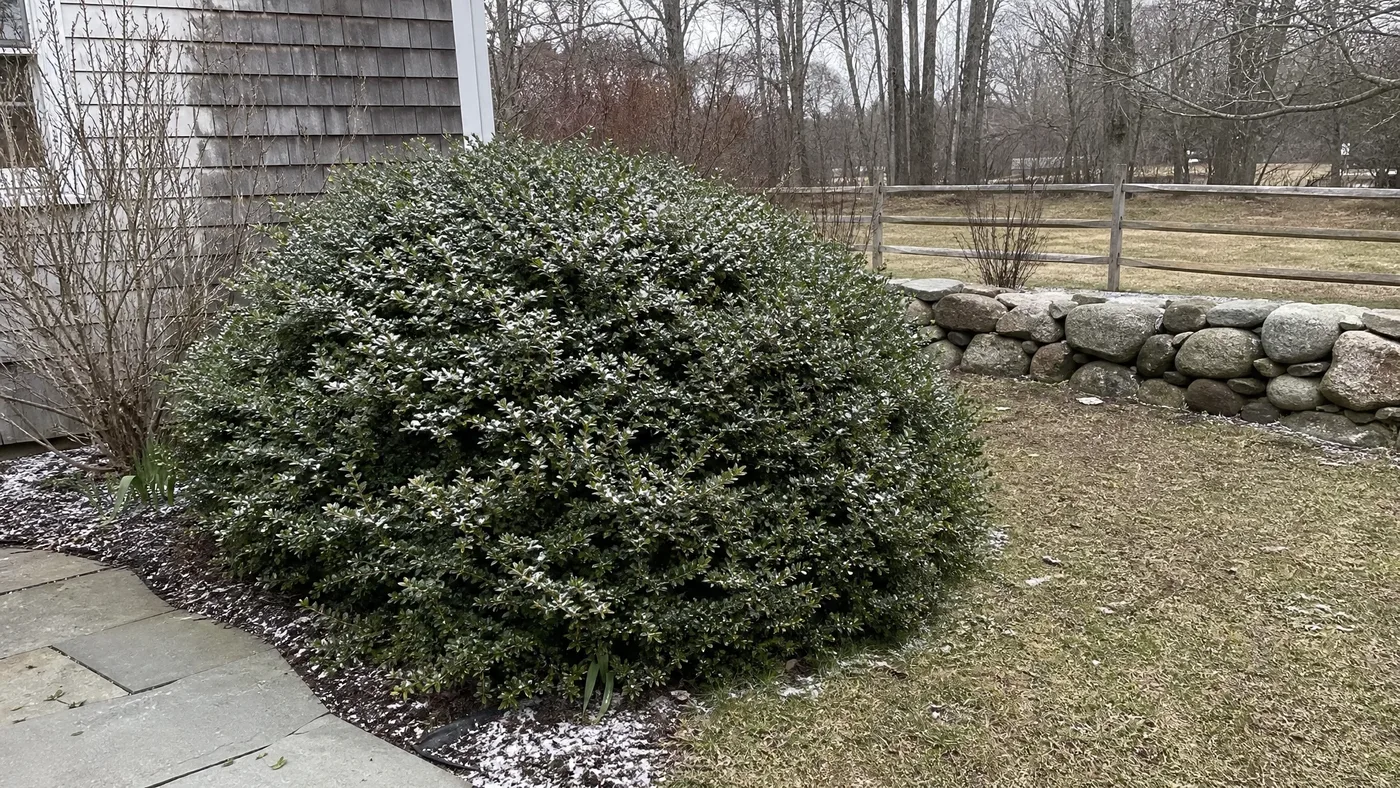
Stand at a window in January and look across the whole yard. The maples are bare sticks, the perennial bed is a brown tangle, and the lawn has gone the color of straw. Which shrubs are still holding color? Mostly one dark green mound beside the front walk, its small leaves packed tight and looking much as they did in July.
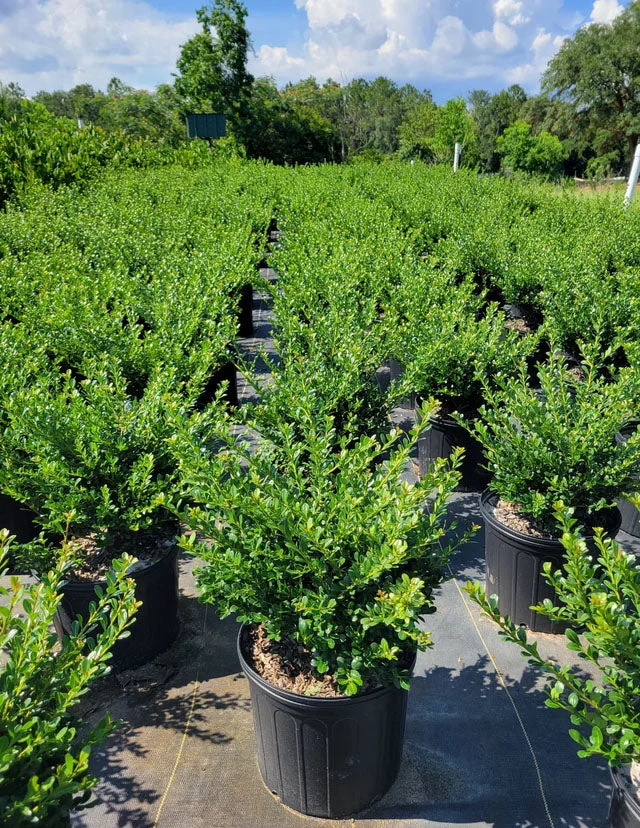
That mound is Compact Japanese Holly, and yes, it is evergreen. Evergreen does not mean unchanging, though. The shrub has a pale spring flush, a dense summer face and a quiet tint in the cold, and each one means something different.
In this article, we'll go through how the shrub looks in each season, what light does to its leaves, and how to tell a normal winter tint from real damage.
Your Winter Yard and Where Compact Japanese Holly Sits
Before looking at one shrub, it helps to see what surrounds it. In winter, a yard sorts itself into plants that left and plants that stayed.
The deciduous trees and shrubs give you structure only, bare branches against the sky. Perennials and grasses fade to tan and straw. Next to them, a dark evergreen mass reads as the anchor of the whole picture, and the eye goes to it first.
Compact Japanese Holly plays that anchor role with a fine touch. Its leaves are small and its form is rounded, so it feels softer than a big-leaf evergreen, and it carries the bed through the months when little else does. At maturity it reaches about 6–8 feet tall and 6–10 feet wide, so the mound by the walk grows into something substantial over the years.
Reading the Neighbors
The holly looks different depending on what stands beside it, so it pays to think about the company before you plant.
Set against bare branches or pale ornamental grass, the dark green stands out and the bed looks planned in January. Set among other dark evergreens, it simply blends in and the yard loses its contrast. Our landscape uses guide covers where it earns its place, from foundation corners to screens.
Compact Japanese Holly Keeps Its Leaves Through Every Season
This is the direct answer to the title. Compact Japanese Holly is an evergreen, and it never goes bare.
Japanese holly is an evergreen shrub or small tree in the holly family, and Compacta is a cultivar of that species. It carries leaves every month of the year. There is no fall color change and no autumn drop.
One of the most common questions we get is whether the leaves fall in autumn, because customers notice a few yellow ones on the ground. They do shed, but gradually. Older leaves deep inside the shrub age out a few at a time while new ones form at the tips, so the canopy never looks bare.
What the Leaf Itself Looks Like
The leaf explains why the shrub looks so tidy. It is small, flat, glossy and spineless.
Compacta's leaves run roughly ½ to ¾ inch long and sit crowded along the stems, a finer scale than the species' range of ½ to 1¼ inches. That gives it a more even look than a large-leaf holly with spiny edges. The upper surface is shiny dark green and the underside is a duller light green.
How It Differs From a Deciduous Shrub
If you are used to shrubs that drop everything in fall, the holly asks you to think in layers instead of seasons.
There is always an old layer, a middle layer and a new layer, and they overlap. That overlap is what keeps the screen solid in February. A boxwood is also evergreen and works much the same way, but its leaves are larger and its look through the year is different from the holly's.
A Pale Green Flush in Spring on Compact Japanese Holly
Spring is when the evergreen shrub shows its most visible change. The old foliage stays dark, and the new growth arrives lighter.
New shoots push out at the tips of every branch in a fresh, light green, with the dark older leaves sitting behind them. The whole shrub looks lit from the edges. The young stems carry a touch of purple as well, since on 'Compacta' young stems are purple.
The flush darkens over the following weeks, until the new leaves match the old ones. By then the shrub has gained a new layer and put on size. Its growth rate is listed as medium, so a healthy plant adds visible growth each year.
Flowers Hidden in the Flush
Blooming comes in this same window, and you could walk past it without noticing.
The species blooms from May to June, and the flowers are small and white with four parts, easy to miss against the foliage. They are fragrant, so a close walk-by is rewarded. Our guide on flowers and berries covers what follows.
Protect the New Growth
A practical point follows from all this. Shearing just before the flush removes the new growth you were about to enjoy.
We tell customers to let the pale tips open and darken first, then shape the shrub. You get the spring color, and the cut leaves a clean outline instead of a row of chopped shoots.
How Solid the Summer Canopy of Compact Japanese Holly Looks
By midsummer the contrast of spring has faded, and the shrub becomes one uniform mass.
From across the garden, you stop seeing leaves at all. You see a single dark, rounded form with a soft sheen where light catches the glossy surfaces. 'Compacta' is a globose form, and in summer that rounded shape reads clearly against lawn and mulch.
This is the look people want from a screen or a foundation planting. The tight, small-leaved branching blocks views and holds its outline without help. At year five, you should see a rounded body with no hollow center, as long as light reaches the whole shrub.
Reading a Row of Plants
In a hedge the summer canopy matters more, because you see the plants as one long wall rather than individual mounds.
Spaced well, neighboring plants knit together until the joins disappear, and the row reads as a single green band along the property line. Spaced too wide, you get a string of separate balls with gaps between.
When Summer Looks Dull Instead
A healthy summer canopy is glossy. If it turns dusty, stippled or pale, something else is going on.
Spider mites are among the occasional pests of Compacta, and a mite problem shows up as a dull, speckled look in hot weather. Heat and humidity at the warm end of its range can also stress it. Check the leaves up close before you blame the weather.
Light and Shadow Across Compact Japanese Holly Foliage
Even in a normal year, one shrub does not show one color. Sun angle and shade change how the leaves read from side to side.
Sun Versus Shade
The cultivar takes full sun, meaning six or more hours of direct light, as well as part shade, and its tone shifts with what you give it.
The upper leaf surface is shiny and dark, so it works like a small mirror. In bright sun the glossy tops throw highlights and the shrub looks lighter and livelier. In shade the same leaves look deeper, almost black-green. A plant in part shade often looks darker and a little more open than one in full sun, which stays tighter.
Turning Leaves and Low Winter Sun
The lower leaf surface is a dull light green, and you see it when wind turns the foliage. On a breezy day the whole mound flickers between dark and pale.
The low winter sun matters most. It hits the south and west faces of the shrub hardest, and those faces are the ones most likely to tint first. If one side of your holly looks different from the other in January, the sun angle is the likely reason.
Bronze Tints and Thin Spots on a Winter Leaf
Move in to branch level in winter and you will see two changes. The leaf color shifts, and the shrub thins a little.
The Bronze or Purplish Cast
Cold and wind can turn the older leaves a shade of bronze or purple, mostly on the exposed side. It is a mild change, and it shows up most at the cold end of the range.
Boxwood does the same thing. It can take on an orange-green cast in winter from wind and full winter sun. Our holly and boxwood comparison sets the two side by side.
The Modest Thinning
Winter also brings a small loss of leaves. A few older leaves on the inner branches yellow and drop, and the shrub looks a little less dense when you look into it.
The outer canopy should still look full. If you can see through the whole shrub, something more than seasonal thinning is happening. For the protective steps in cold zones, see our winter care guide.
When Winter Color Is Normal and When It Is Not
A tint is not damage, and customers often cannot tell which they are looking at. We often see worried February messages about a bronze holly that turns green again in April.
The table below sets the ordinary signs next to the ones that call for action.
| What you see | Usually normal | Worth acting on |
|---|---|---|
| Leaf color | A bronze or purplish cast on the exposed side that fades as the spring flush arrives | Leaves that turn fully brown or look bleached, mostly on the windward side |
| Leaf drop | A few older inner leaves yellowing and falling | Bare branch tips or whole branches with no new growth in spring |
| Overall tone | Slightly duller green in deep winter | Yellowing across the whole shrub, which is worth a soil check because it dislikes alkaline soil |
| Summer surface | Glossy and even | Dull stippling that suggests mites |
Clemson's extension notes that boxwood foliage almost always reverts to green in spring, and mild tints on the holly usually fade the same way. In severe cases, though, wind- or sun-struck foliage can turn completely brown or even bleached. That is real desiccation, not a tint.
How Zone Changes the Picture
Your zone decides how much of this you will see. Compacta grows in zones 6a through 8b, while the species reaches into zone 5.
At the cold edge, expect more bronzing and more wind burn, and plant in a protected spot. In warmer gardens the foliage stays a steadier dark green, and summer heat and humidity are the stresses to watch. Take extra care with heat and humidity in zones 8 and 9. Our hardiness zones guide goes deeper.
Wait Before You Cut
The usual reflex is to prune out anything that looks off in late winter. We tell customers to wait until the spring flush has opened.
Bronzed leaves can recover, and real dead wood shows itself once new growth starts everywhere except the damaged branches. Cutting early removes tissue that may have come back and leaves holes that take a season to fill.
One Leaf Up Close, Through the Year
Everything above comes down to one small leaf. Follow it from spring to winter and you see the whole story.
In spring it opens pale green, soft and slightly lighter than anything around it. By early summer it has deepened to the dark glossy green of the older foliage, flat and spineless, with its shiny upper face turned to the sky.
Through summer and fall it holds that color, and its pale underside only shows when the wind turns it. In the first hard winter weeks, an exposed leaf may take on a faint bronze or purple cast, the same way its neighbors do. It stays on the branch the whole time.
When a leaf finally ages out, usually deep inside the shrub where nobody is looking, another has already opened at the tip to replace it.
Compact Japanese Holly, Still Dark Green in April
Compact Japanese Holly is evergreen in every season, and what changes is shade and tone. Spring brings a pale flush, summer a solid dark canopy, and winter a modest bronze cast with a little inner thinning. Brown, bleached or bare branches mean real trouble, and everything else is the plant doing its seasonal work.
Compact Japanese Holly
Nursery-grown Compact Japanese Holly in sizes from 1 Gallon Shrub, shipped to your door.
From $80.55
Shop Now →On a cold January afternoon, one dark leaf catches the low light and holds it, and in a few months the pale new growth will arrive to join it. Customers come back to us for hollies that keep that deep green and tight outline through the bare months, which is what a small business growing and selling top-quality shrubs on its own farms can promise with a plant like this.