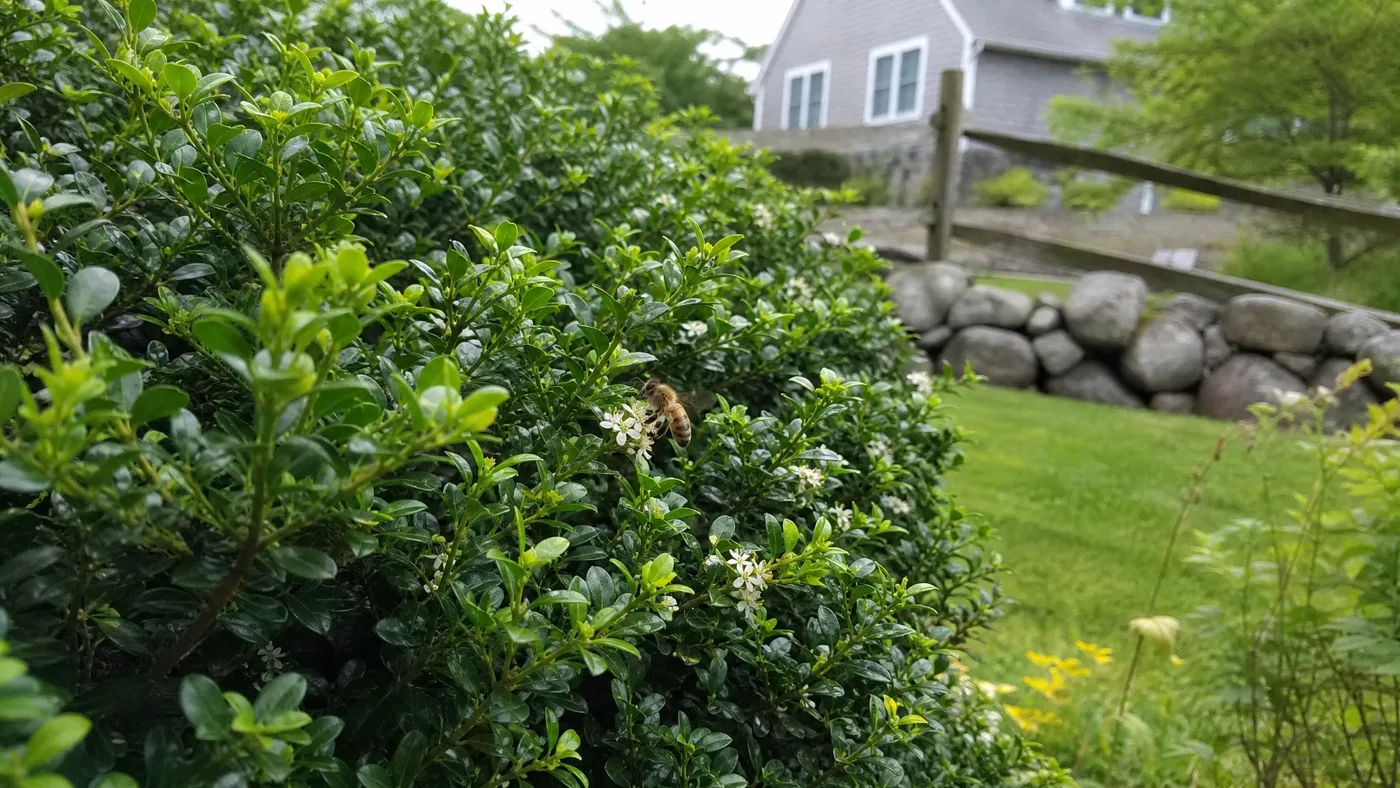
Do Compact Japanese Holly Plants Flower and Set Berries?
In late August you crouch beside one holly and find tiny black beads hanging under the leaves. Three feet away, an identical plant carries nothing at all. It has the same glossy leaves, the same size and the same shearing, and neither plant is sick.
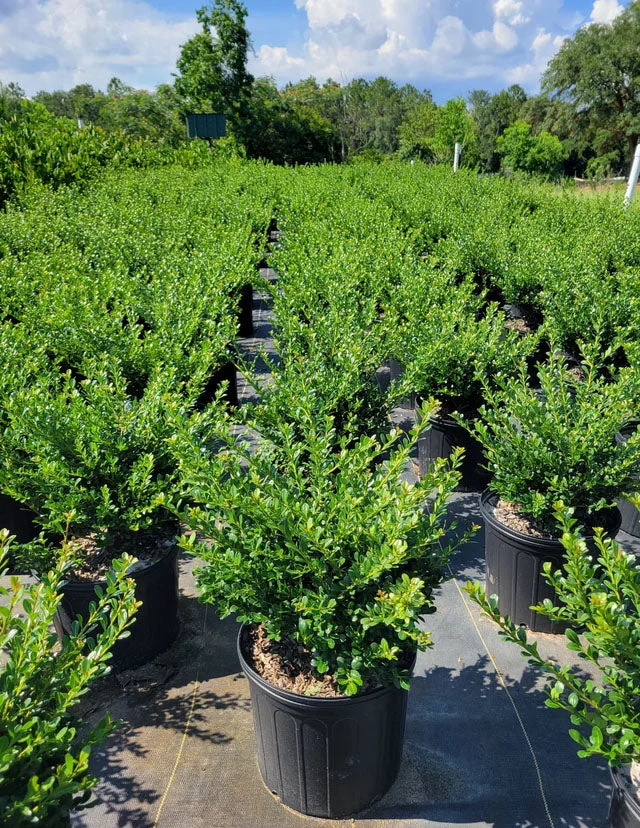
The difference was settled months earlier, in flowers most people never notice. It comes down to which plant is male and which is female. Misread it and you can wait years for fruit that will never come, or buy a second shrub to fix a problem that was never there.
We'll walk you through the flower itself, then the male and female split and how bees bridge it, then the black berries. After that we'll show you how to count the pollinators around your yard and how to read a plant that stays bare.
Inside the Tiny Spring Flowers of Compact Japanese Holly
Before the berry question makes sense, you need to know what the flower is and when it appears. Here is what happens on your shrub each spring.
When the Blooms Open
Japanese holly blooms from May to June. That puts the show in late spring, after new growth has pushed out and often just when you are thinking about the first shearing of the year. A warm spring and a cold one shift the dates, so watch your own plant rather than the calendar.
The Four Parts of the Flower
A flower is a small machine for making seed, and each part has a job. On this holly the pieces are few and tiny.
Oregon State's landscape plant profile describes the flowers as small, 4-parted and white. The white petals form the visible ring, and green sepals beneath them protected the bud. Inside sit the working parts: the stamens, which make pollen, and the pistil, whose ovary is where a fruit can begin.
Here is the detail that matters for the rest of this guide. On a holly, one flower usually has only one set of working parts fully developed. Male flowers have functioning stamens, and female flowers have a functioning pistil. The next section explains why that matters.
Why You Probably Missed Them
The blooms are small, they sit tucked in among the leaves, and the shrub is a dense dark evergreen with no showy display behind them. Most people notice the bees or the scent before they see a flower, since the blooms are small, fragrant and attractive to bees.
Shearing makes it worse. A hedge trimmed in May loses many of its flower buds, so owners can live with these shrubs for years without ever seeing a bloom. The flowers are there. The shape you keep is simply tighter than the shape the flowers need.
Why Some Plants Are Male and Others Female
Many shrubs carry pollen parts and seed parts on every plant. Holly does not work that way, and this one fact explains the puzzle we opened with.
What Dioecious Means
Botanists call a species dioecious when its sexes live on separate plants. The word comes from Greek for "two houses," which is a fair picture. Pollen is made in one house and seed in the other. Japanese holly is dioecious, with male and female flowers on separate plants, and a male must be present for the female to be pollinated and produce fruit.
So only the female can ever make a berry. Think of the male as a pollen supplier and the female as the only plant with a nursery for seed. Neither can finish the job alone.
Which Sex Compacta Is
'Compacta' is male. NC State's cultivar page states that this cultivar is male and does not bear fruits. It adds that the best-known 'Compacta', introduced by Tingle Nursery, is male too. A properly labeled Compact Japanese Holly will not set a berry however old it gets or however well you treat it.
That is why the species and the cultivar give different answers. Ask whether Japanese holly has berries and the species answer is yes, on pollinated females. Ask about 'Compacta' and the answer is no. The fruiting holly three feet away in our opening puzzle was a different plant, a female of another Japanese holly cultivar. Our comparison of Compacta and Helleri covers how the look-alikes differ in form.
How Pollen Travels From One Shrub to Another
A holly cannot carry its pollen across the yard. It relies on insects, and the bees working the shrubs in May and June do the job.
The Trip a Bee Makes
A bee lands on a male blossom to feed and leaves dusted with pollen. At the next flower it visits, some of that dust rubs onto the pistil. If that flower is female, the pollen starts a seed forming, and over the summer the ovary swells into a fruit. If the next flower is another male, nothing happens and the bee moves on.
Both sexes bloom in the same May to June window, which is what makes the handoff possible. The fragrance of the blooms is the plant's way of calling the bees in.
How Far the Trip Can Be
The sources we rely on give no pollination distance for Japanese holly, so we won't make one up. Bees are strong fliers and a trip can cross a property line, but the closer the male, the more female flowers get visited by a bee that has just worked a male. Your local extension service can tell you what range works in your area.
Weather plays a part. Cold, wet days during bloom keep bees home, and a poor week can mean a thin crop even with a male next door. A male sheared hard during bloom also offers fewer flowers, and fewer flowers means less pollen in the air.
Compact Japanese Holly Berries Are Black, Not Red
When people picture holly berries, they see red ones against dark leaves. Japanese holly breaks that picture, and it helps to know what you are looking for.
What the Fruit Looks Like
The fruit is a black, globose, berrylike drupe on pollinated female plants. Globose means round. A drupe is a fleshy fruit around a hard stone, the same build as a cherry. Red-berried hollies such as yaupon are a different story, and the Arkansas extension service notes that Japanese holly fruit is black.
Timing and Staying Power
The fruit ripens in early fall and persists into spring. That gives you a long window to check a female plant, well after the flowers are forgotten. The same page notes the fruits are hidden below the foliage, so look under the branches rather than at the top of the shrub.
Don't Plant for the Display
The Arkansas extension service says the fruit on dwarf Japanese holly and yaupon will not add greatly to your landscape. We agree. Black beads under dark leaves are a curiosity, not a feature. If you want a berry show, plant a red-berried holly and keep Compact Japanese Holly for what it does best, which is year-round shape.
One practical note. Human ingestion of the berries can cause a minor toxic reaction. Our guide on toxicity for pets and children covers that in detail, and it only matters if a female is fruiting nearby.
Counting the Plants Within Bee Range
The biology gives you a simple rule. Every female needs a male near enough for a bee to carry pollen, and that includes males you do not own.
One of the most common questions we get is why a neighbor's holly is loaded with berries when theirs has none.
Start With Your Own Yard
Walk your property and list every Japanese holly. A Compact Japanese Holly counts as a male, so any hedge of it is a pollen source. If every holly you own is 'Compacta', you have males only, no berries and nothing to fix. If you have a female of another cultivar and no male, that is where fruit fails.
The Compact Japanese Holly we grow is the male 'Compacta', so it gives you flowers and pollen but never fruit.
Count the Neighbors
Look over the fence and across the street. A neighbor's sheared 'Compacta' row may supply all the pollen a female needs. It works in reverse too, and a female next door may fruit thanks to your male. You cannot tell the sexes by their leaves, so ask what was planted or look for berries in fall.
Pollinator Count Checklist
Use this list before you buy anything.
- Identify every Japanese holly on your lot and note which are labeled 'Compacta'.
- Check neighboring yards for Japanese hollies, hedges and foundation plantings.
- Look under the foliage of any suspected female in October for black fruit.
- Ask your local extension service how close a male needs to be in your area.
What a Berryless Compact Japanese Holly Is Telling You
A holly with no fruit is not necessarily a problem. A handful of causes cover almost every case, and the table below sorts them by what you will see.
| Cause | What you will see | What to do |
|---|---|---|
| Plant is male 'Compacta' | Flowers every spring, never any fruit | Nothing. This is normal. |
| Female with no male in bee range | Flowers, but no fruit forms | Add a male or find out where a neighbor's male stands. |
| Shearing during bloom | Few or no flowers | Wait until the May to June bloom ends before trimming. |
| Young or sparse plant | Little flowering and little fruit | Give it seasons to fill out. |
Start With the Label
Sex comes first because it decides everything else. If your plant is labeled 'Compacta', the question is closed. We often see owners blaming soil or watering for a berryless plant when the answer is simply the tag.
Rule Out Pruning and Age
Compact Japanese Holly tolerates pruning well enough for topiary and formal gardens, which is why so many are sheared tight and grown for foliage. Our guide to pruning Compact Japanese Holly covers the timing for shaping.
Age matters too. A young plant with few branches carries few flowers, and a female needs flowers to make fruit. Our look at how big and fast-growing it gets shows how long filling out can take.
Before you decide a female is barren, check under the foliage. The fruit is hidden there, and plenty of owners have berries and do not know it.
Flowers, Fruit and Your Planting Plan for Compact Japanese Holly
If berries do not matter to you, plant 'Compacta' and ignore the fruit question. It is a dependable shrub for the uses in our guide to landscape uses for Compact Japanese Holly. If berries do matter, you need two plants: a confirmed female Japanese holly cultivar and a male such as 'Compacta' within bee range. Given the extension view that the fruit adds little, we usually tell customers to buy for shape and let the berries go.
Compact Japanese Holly
Nursery-grown Compact Japanese Holly in sizes from 1 Gallon Shrub, shipped to your door.
From $80.55
Shop Now →The flowers happen every spring regardless, while the berries depend on a neighbor. Our growers, who raise and sell top-quality shrubs on our own farms, watch these plants through the May and June bloom, check for hidden fruit in fall and see how each one holds its shape into winter.