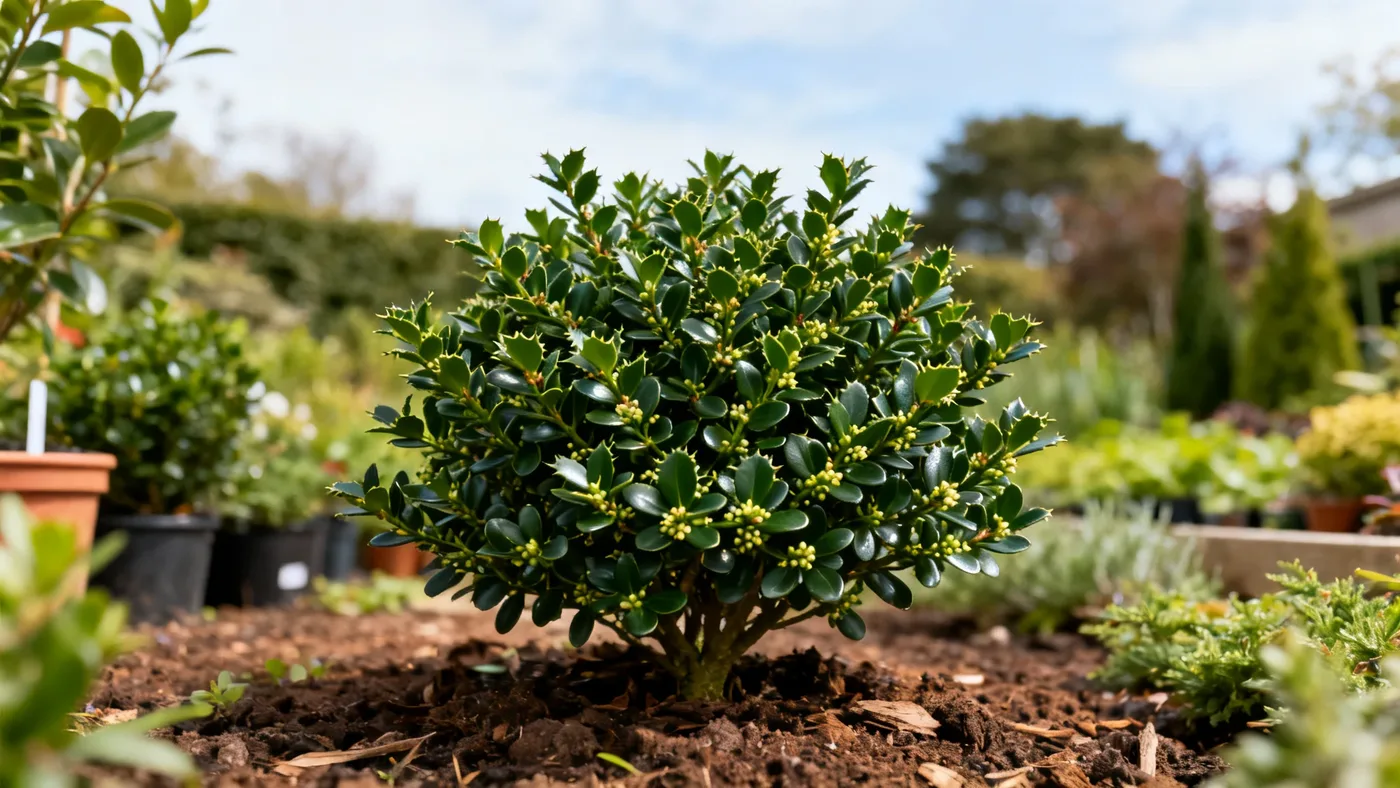
Do You Need to Fertilize Compact Japanese Holly?
Compact Japanese Holly is a slow grower by design. Unlike plants that surge through spring and summer demanding constant nutrition, this evergreen shrub gets by on modest feeding. But modest doesn't mean none. The question isn't whether to fertilize, but how to do it right for a shrub that thrives on restraint.
Light annual feeding in early spring sets your Compact Japanese Holly up for steady, healthy growth without pushing excessive soft foliage that wastes energy and invites pests. Too much fertilizer is a bigger risk than too little with this plant. Here's what you need to know to get it right.
Why Fertilize at All?
Compact Japanese Holly grows roughly 3 to 6 inches per year. That slow, compact habit is one reason it's such a reliable choice for hedges and foundation plantings. But even slow-growing plants need nutrients to maintain that dense, dark green foliage and develop the structure you're shaping with pruning.
Fertilizing isn't about forcing growth. It's about supporting the growth that naturally occurs and ensuring your plant has what it needs to recover from pruning, withstand stress, and maintain its ornamental form year after year.
A single application of the right fertilizer in early spring is usually all an established Compact Japanese Holly needs. Newly planted shrubs may benefit from a light application in their first year as they establish roots.
Start with a Soil Test (Especially in Alkaline Areas)
Before you buy any fertilizer, know what your soil is actually offering. Compact Japanese Holly prefers acidic soil, ideally in the range of 5.0 to 6.5 pH. In alkaline soil, the shrub becomes chlorotic (yellowing) as it struggles to access iron and other micronutrients.
If you live in an area with naturally alkaline soil, you have two paths forward. The first is to amend your soil toward acidity with sulfur or aluminum sulfate before planting, and maintain that adjustment over time. The second is to apply an acid-forming fertilizer designed for acid-loving plants.
A soil test from your local cooperative extension service (usually inexpensive) will tell you your soil's current pH and nutrient levels. This one step saves guesswork and money. It also helps you decide whether you need to adjust pH at all, or whether your soil is already in the sweet spot.
Choosing the Right Fertilizer
Look for a balanced or acid-forming fertilizer. "Balanced" means the three main nutrients (nitrogen, phosphorus, and potassium) are present in roughly equal ratios, such as 10-10-10 or 5-5-5.
For Compact Japanese Holly, an acid-forming holly or azalea fertilizer is often the better choice. These products are formulated to lower soil pH slightly over time while feeding the plant, which is exactly what this shrub needs, especially if your soil tends toward neutral or slightly alkaline.
Avoid high-nitrogen fertilizers or lawn fertilizers. Excess nitrogen pushes soft, tender new growth that wastes the plant's energy, creates dense shade that can trap moisture, and makes the shrub more attractive to spider mites and other pests. The whole point of growing Compact Japanese Holly is its naturally slow, controlled growth. Don't work against that.
Organic options include composted bark, well-aged manure, or plant-based fertilizers. Synthetic granular or liquid fertilizers work too, as long as they're balanced or acid-forming. The choice between organic and synthetic matters less than the nutrient profile.
When to Fertilize
Timing is critical. Apply fertilizer in late winter to early spring, before new growth flushes. In most climates, this means February through early April, depending on your location. The idea is to have nutrients available as the plant breaks dormancy and begins its growing season.
Do not fertilize in late summer or fall. This can push tender new growth that won't harden off before frost, leaving the shrub vulnerable to winter damage and stress.
For established plants in the landscape, one application per year is sufficient. Container-grown Compact Japanese Holly may benefit from a second light application in early summer (June) since nutrients leach from pots more quickly, but this is optional.
How to Fertilize: Step-by-Step
Materials You'll Need
- Acid-forming holly/azalea fertilizer (granular or liquid)
- Measuring cup or scoop (if using granular)
- Watering can or garden hose
- Gloves (recommended for granular formulas)
- Soil pH kit or prior test results (optional but helpful)
Application Steps
- Check the weather and soil moisture. Fertilize when soil is moist but not waterlogged. Avoid application right before heavy rain that could cause runoff, or during drought when the soil is dry. A day after rain or watering is ideal.
- Read the product label carefully. Follow the manufacturer's recommended rate for the square footage or number of shrubs you're treating. Rates vary by product, so don't assume a standard dose.
- For granular fertilizer: Sprinkle the product evenly around the base of the shrub, staying 6 inches away from the stems. Cover the area from the trunk out to the drip line (roughly where the outer branches end). Use the recommended amount without heaping or concentrating it in one spot.
- For liquid fertilizer: Dilute according to the label, mix well, and apply to the soil around the base. Avoid spraying foliage unless the product specifically says it's safe as a foliar feed.
- Water thoroughly after application. This moves the fertilizer into the root zone and helps prevent nutrient burn. Water gently but deeply, ensuring moisture penetrates 6 to 8 inches into the soil.
- Do not apply fertilizer directly against stems or branches. Keep it in the soil layer where roots can access it. Contact with stems or foliage can cause damage.
Fertilizing Container Plants
Compact Japanese Holly grows well in containers on patios or near entries, but pots require slightly different fertilization since nutrients leach through drainage water. Use the same acid-forming fertilizer at the same timing (early spring), but at half the recommended landscape rate. Water thoroughly after application.
If your container plant is in a large pot (5 gallons or more), one spring application is usually enough. In a smaller container (under 3 gallons), consider a second light application in early June to replenish nutrients. Always err on the side of less rather than more, since container soil stays richer than landscape soil and you're watering more frequently.
Recognizing Over- and Under-Fertilizing
Signs of Over-Fertilizing
- Excessive new growth that looks tender and bright green (normal foliage is dark and dense)
- Leaves with burned or scorched edges
- Salt crust on the soil surface or inside pot rim
- Increased pest pressure, especially spider mites
- Weak branch structure or leggy growth
Signs of Under-Fertilizing
- Yellowing foliage (though this is more often a soil pH issue than nutrient deficiency)
- Slow or stunted growth even after several years in good conditions
- Pale or dull leaf color
- Poor recovery after pruning
If you suspect over-fertilizing, stop fertilizing and water deeply to leach excess salts. If you suspect under-fertilizing, check your soil pH first. An acidic soil deficiency is often the real culprit, not lack of nitrogen.
Common Mistakes to Avoid
Fertilizing too often. One application per year is the standard for landscape plants. Twice-yearly feeding is rarely necessary and risks pushing excessive growth.
Using lawn fertilizer or high-nitrogen products. These formulations push fast, tender growth that contradicts the whole appeal of this slow, controlled shrub. Holly-specific or azalea-type fertilizers exist for a reason.
Ignoring soil pH. If your soil is alkaline and you're seeing yellowing despite regular fertilizing, the problem is pH, not nutrient availability. No amount of standard fertilizer will fix chlorosis caused by high pH.
Fertilizing newly planted shrubs too heavily. Newly planted Compact Japanese Holly needs to establish roots first. A light application of balanced or acid-forming fertilizer in early spring of the first year is fine. Heavy feeding while roots are still developing can actually harm establishment.
Applying fertilizer in late summer or fall. This pushes new growth that won't harden before winter frost. Stick to early spring, before growth begins.
Fertilizing during drought. Always ensure soil is moist before applying fertilizer. On dry soil, fertilizer can burn roots instead of feeding them.
What to Expect
After one year of proper spring fertilizing, you should notice denser foliage and a richer, darker green color. Growth will remain slow and controlled, which is exactly right. Don't expect Compact Japanese Holly to suddenly grow much faster. Its genetics dictate that it will add roughly 3 to 6 inches per year regardless of fertilizing. The benefit of fertilizing is maintaining vigor, dense habit, and the plant's ability to recover from pruning.
Over five to ten years, properly fertilized and pruned Compact Japanese Holly will reach its mature height of 3 to 4 feet. This slow, steady progress is the hallmark of healthy shrubs in this genus, not a sign that fertilizing isn't working.
For more on Compact Japanese Holly care, including pruning and watering schedules, see our complete care guide.
Fertilizing Quick Reference
| Factor | Recommendation |
|---|---|
| Timing | Early spring (Feb-Apr), before new growth flushes |
| Frequency | Once per year for landscape plants; twice per year optional for small containers |
| Fertilizer type | Balanced (10-10-10) or acid-forming (holly/azalea-type) |
| Avoid | High-nitrogen, lawn fertilizers, late-summer application |
| Soil pH target | 5.0 to 6.5 (acidic) |
| Expected growth | 3 to 6 inches per year (fertilizer supports health, not speed) |
| Container rate | Half the landscape rate, applied to moist soil |